
Agentic Knowledge Management: The Next Evolution of PKM
We're using AI backwards. Instead of invoking AI, AI should invoke us for approval. Welcome to Agentic Knowledge Management.

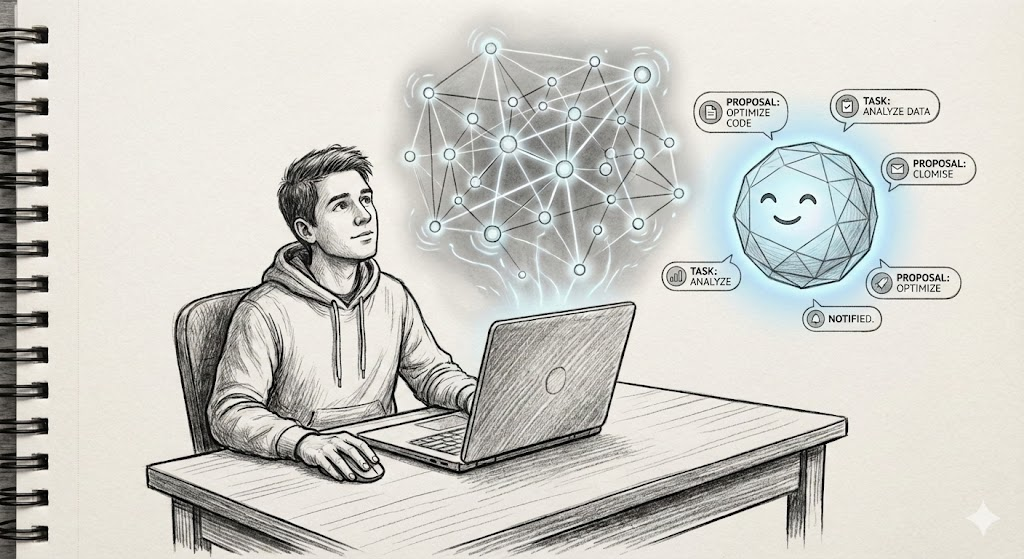
We're using AI completely backwards. And I know what's wrong.
In this article, I want to introduce you to a concept I've been thinking about and experimenting with: Agentic Knowledge Management (AKM). It's a paradigm shift in how we interact with AI within our knowledge systems. And I believe it's where Personal Knowledge Management (PKM) is inevitably heading.
Introduction
We've all gotten used to AI as a chat interface. You open ChatGPT, Claude, or whatever tool you prefer, type a prompt, get a response, and then... you do the work. You copy-paste. You switch contexts. You execute the tasks manually.
But this is fundamentally reactive. YOU invoke the AI. YOU ask the questions. YOU do the heavy lifting.
What if we flipped this completely?
What if AI was watching your knowledge base all day long, knowing about your goals, projects, plans & tasks; understanding your intentions, and proposing actions before you even asked? What if your AI assistant didn't wait for commands, but anticipated your needs and offered to help?
I've been experimenting with this approach, and it's closer to reality than most people realize.
TL;DR
Agentic Knowledge Management (AKM) is an emerging paradigm where AI assistants proactively interact with your knowledge base, monitoring changes and autonomously executing tasks based on your intent.
Here are the key points:
- Current AI tools are reactive: you invoke them explicitly
- AKM flips this: AI monitors your knowledge base and proposes actions
- The AI operates with a "heartbeat," waking up periodically to scan for changes (i.e., it's "alive")
- Human-in-the-loop ensures you stay in control while AI handles execution
- Your knowledge base becomes the AI's brain; not just yours
- This requires structured knowledge systems (e.g., the Obsidian Starter Kit)
- Real-time sync/multiplayer is the missing piece for optimal implementation
- Security and trust are managed through approval-based workflows
- AKM transforms AI from a tool you use into a digital extension of yourself
- The future of Personal Knowledge Management (PKM) is proactive, not reactive
The Problem With Current AI Integration
Most people think they're leveraging AI well because they use ChatGPT or Claude regularly. But that's so 2023!
Manual task execution: You write a task in your daily note: "Cross-post article to Dev.to." Then you open a new tab, log into Dev.to, copy your article, format it, and publish. The AI never even knew about that task.
Constant context switching: Every time you need AI help, you break your flow. You leave your knowledge base, open a chat interface, provide context (again), get a response, then return to what you were doing. This kills productivity.
Reactive usage patterns: You only get AI help when you explicitly ask for it. Meanwhile, opportunities for automation pass you by because the AI has no visibility into your actual work.
This is NOT how AI should work with knowledge systems.
Similarly, AI has a very limited memory of its own, completely disjoint from your knowledge base. I now consider that to be a very limited approach.
What Is Agentic Knowledge Management?
Agentic Knowledge Management (AKM) is a Knowledge Management approach where AI assistants proactively interact with knowledge bases, monitoring changes and autonomously executing tasks based on user intent.
The key word here is proactive.
Instead of waiting for you to invoke it, an agentic AI assistant:
- Monitors your knowledge base for changes (new notes, updated tasks, modified projects)
- Knows about you and your current context: What you do, why, your plans, your goals, your projects, your plans, your tasks, your vision, your Personal Manifesto, your writing style, etc
- Understands your intent by analyzing your knowledge base and what you are currently doing (e.g., adding a to-do item implies you want/need something done)
- Proposes actions before executing them ("I noticed you want to cross-post this article. Should I handle it?")
- Executes with permission once you approve
- Reports back by updating the status in your knowledge base
This is fundamentally different from basic AI integrations that can be found in many tools/platforms today. Those are still reactive. You highlight text and ask for help. AKM is about the AI being always-on, always-aware, and always-ready to act on your behalf.
The Digital Twin Concept
Think of AKM as building a digital version of yourself.
Your knowledge base already contains your thoughts, processes, projects, processes, preferences, etc.
When you give an AI assistant read-write access to that knowledge base, you play a different game: AI starts to understand YOU.
It learns your writing style from your notes. It understands your workflows from your processes. It knows your priorities from your task lists. It recognizes your patterns from your daily notes.
Over time, this AI becomes less like a tool and more like a Digital Twin; a virtual extension of yourself that can act on your behalf with appropriate oversight.
You can build a mind from many little parts, each mindless by itself — Marvin Minsky
Your knowledge base is already those "many little parts." AKM is about connecting them to an AI that can reason over them and act.
How It Actually Works
Let me walk you through a concrete example of how AKM works in practice:
The Workflow
- You add a task to your daily note: "Cross-post my latest article to Dev.to"
- AI detects the change: The assistant has a "heartbeat". It wakes up every minute (or faster) and scans for modifications
- AI understands intent: It recognizes this is a task that could be automated
- AI proposes action: It writes a response directly in your note: "I can handle this. Should I cross-post the article now? [Yes/No]"
- You approve: You simply write "Yes" or click a button
- AI executes: It cross-posts the article, handling formatting and publishing
- AI reports back: It updates your note: "✅ Cross-posted to Dev.to: [link]"
All of this happens inside your knowledge base. No context switching. No copy-pasting. No manual work.

My OpenClaw Experiment
I've been experimenting with OpenClaw, an open-source AI assistant platform that you can self-host and connect to various channels like WhatsApp, Telegram, Slack, email, and more.
Here's what I did:
- Set up OpenClaw on a secured Virtual Private Server (VPS) (cfr OpenClaw VPS Configuration Guide)
- Connected it to my knowledge base with read-write access
- Configured it with a heartbeat to wake up every minute
- Gave it context about my processes, writing style, and preferences
The results are promising. The AI now monitors my vault, understands my note structure (thanks to the Obsidian Starter Kit's well-defined templates and schemas), and can propose actions based on what I write.
It's not perfect yet. There's latency, and the interaction patterns need refinement. But it's absolutely usable TODAY.
The Technical Requirements
For AKM to work well, you need a few things in place:
1. A Structured Knowledge Base
Random, unstructured notes won't cut it. The AI needs to understand your system. This is where having a well-designed Personal Knowledge Management System (PKMS) pays off massively.
With the Obsidian Starter Kit, for example, the AI can leverage:
- Defined note types with consistent metadata
- Templates with predictable structures
- Schemas that clearly describe valid note formats
- Clear folder hierarchies and tag systems
- ...
 Knowledge Forge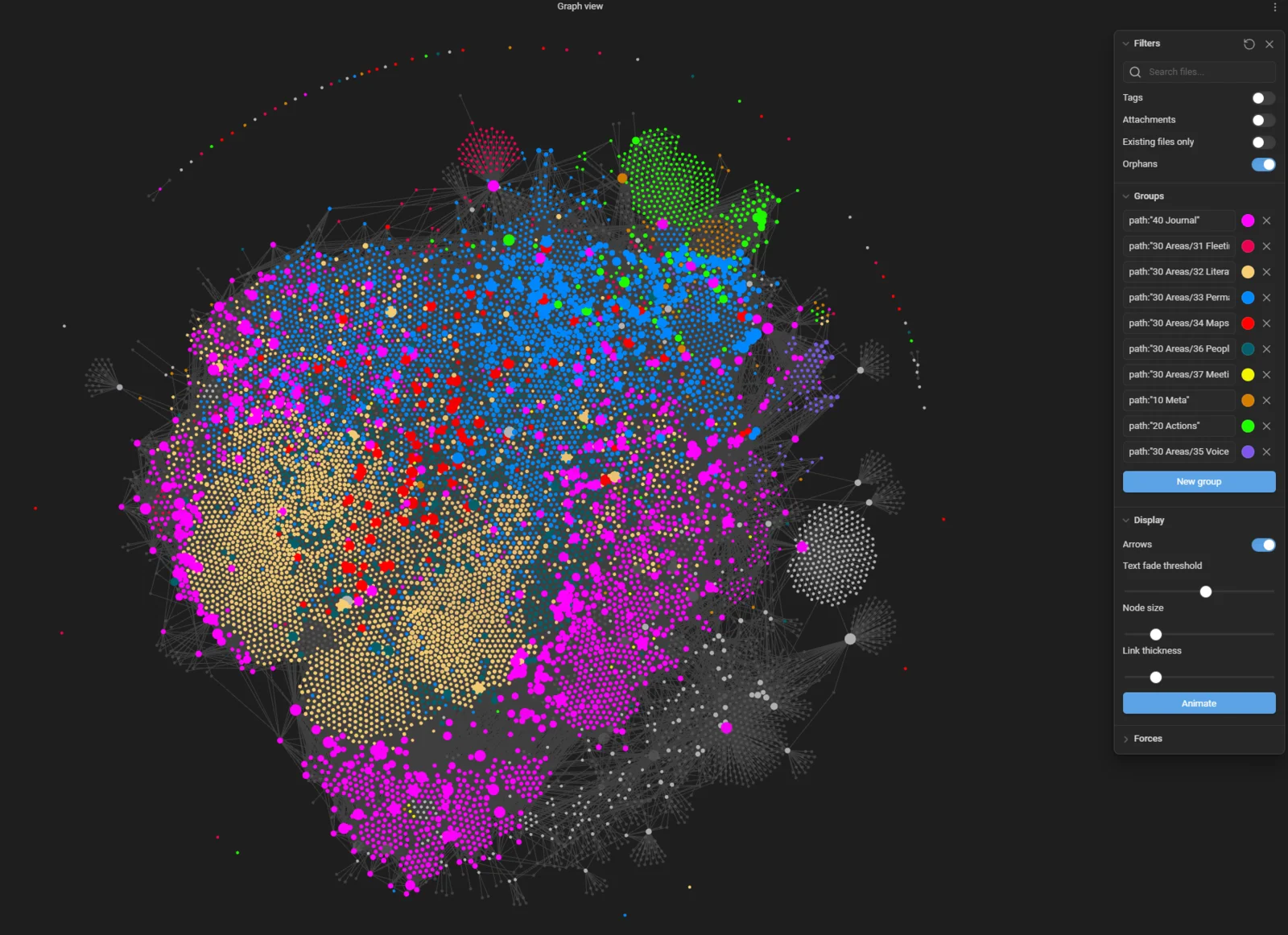
The more structured your knowledge base, the better AI can reason over it and find what it needs.
This goes against the trend of people using fewer and fewer folders because it simplifies everything and because you can use things such as Obsidian Bases to resurface information.
I have no doubts that it will ultimately be okay to simplify further, but at this point in time, more structure does help reduce "noise" for AI. It simplifies search, consistency, etc.
2. Read-Write Access for AI
This is where most people will (understandably) get uncomfortable. Giving AI write access to your precious notes? Scary.
But with proper guardrails, it's manageable. The Human-in-the-Loop approach means AI proposes before it executes. You maintain control. The AI just handles the tedious execution.
For instance, what I do is ask my assistant to send Pull Request (PR) to my notes Git repository. I might go further in the near future, but I prefer to remain on the safe side while I'm exploring further.
3. Change Detection Mechanism
AI needs to know when things change. There are several approaches:
- Git-based sync: Using commits as change sets
- File watchers: Listening to file creation/modification events
- File synchronization services: Syncthing, Obsidian Sync and the like
- WebSockets: Real-time bidirectional communication (i.e., you let AI know when something happens, and it can also let you know)
- "Multiplayer" mode: The next level (more on this below)
4. Multiplayer Mode
This is the missing piece in the Obsidian world. And honestly, I think that the Obsidian team should make multiplayer their top priority. I know it's on their roadmap, but I really think it deserves more attention ASAP.
Multiplayer goes beyond mere file synchronization. With a real multiplayer mode, it becomes possible to edit files together. You see what others are doing, where their mouse pointer is, what lines they're busy editing, etc. It's synchronization on steroids with conflict resolution baked in.
With multiplayer support, AI would not only know exactly what changed, but it would be able to interact with you directly and seamlessly.
Git commits and file synchronization both work, but they're limited. True multiplayer would make AKM seamless; much more interactive and frictionless.
Addressing the Skeptics
I know what some of you are thinking. Let me address a few objections you might have:
"Isn't this just automation with extra steps?"
No. Traditional automation is trigger-based and "dumb". It doesn't understand context or intent. AKM is about an AI that reasons about your knowledge and proposes intelligent actions with a deeper understanding of your current context and goals.
"I don't want AI touching my notes"
Understandable. But consider that you can limit AI to only proposing changes to you. Every action is proposed first. You're always in control. And the upside (having a digital assistant that handles tedious tasks) is really valuable.
"This sounds impractical with current latency"
Fair point. There IS latency. But a few seconds delay is acceptable for most tasks. And this is only getting faster. What matters is whether the model works. And it does. Plus you may give multiple "missions" in parallel to year, easily going beyond your own ability to keep up.
"What about security and privacy?"
This is the most valid concern.
You HAVE to be careful with the AI models you choose to use, what information you give access to, etc. This goes well beyond the scope of this article.
What you should do:
- Self-host your AI assistant
- Favor local AI models you fully control (unfortunately at this point in time, those are far behind frontier models)
- Use secure connections
- Don't expose anything directly on the Internet (e.g., leverage tools such as Tailscale and Secure Shell (SSH))
- Keep sensitive data out of the automation scope
- Make SURE you understand the Lethal Trifecta for AI Agents
- Don't feed your AI access to risky content/data (e.g., random Web pages, emails, etc) that might contain Prompt injection attacks
- Apply the Least Privilege Principle (cfr Zero Trust Security): limit the access you grant, set expiration dates for those permissions, make sure you stay in the loop, etc
- Don't install the AI agent(s) on your own computer (way too risky!)
- ...
The Human-in-the-Loop approach is itself an important security mechanism. Nothing happens without your explicit approval.
But consider that this is all bleeding edge. The more access and autonomy you grant AI agents, the more you'll be at risk. There's no "100% secure" AI usage. And that won't change until Large Language Models (LLMs) become able to differentiate between data and instructions.
Why This Matters for Creators
If you're a creator; writing articles, building courses, managing newsletters, promoting products, etc, AKM is something you want to learn more about right now.
Think about all the repetitive tasks you do:
- Cross-posting content to multiple platforms
- Formatting articles for different outlets
- Scheduling social media promotion
- Updating project statuses
- Tracking publication dates
- ...
All of this could be handled by an agentic AI that understands your content system, your business, and executes with your permission.
With AKM, you become the director of your knowledge operations, not the executor. You make decisions. AI handles implementation.
A few practical examples
Here are a few practical examples of how this could be used:
- Add a task to your daily note -> have AI do it or give you input (eg relevant ideas, actionable plan, etc)
- Improve/harmonize your tags
- Move notes where they belong & propose improvements
- Add/improve other metadata on autopilot
- Analyze the discrepancy between your goals and actions
- Prepare article drafts for you
- Help you review your backlog/prioritizing tasks etc
- Understand when to chime (eg "You could also do X or add Y")
- Add summaries, references, related notes, etc
- Do research for you and giving you the information right in your knowledge base where you need it
- Improve your system over time based on usage patterns
- Build tools for you automatically
- ...
But it could actually go well-beyond that. Just this weekend while experimenting, I setup an automated system to pick random concepts from my notes and prepare social media posts for me, promoting my creations, my ideas, my thinking. Of course you might not like this example, but as a creator, I HAVE to promote my work, so this is very valuable.
I shared some other fun things I've done on X:
Fun things I've done with @openclaw over the weekend...
— Sébastien Dubois (@dSebastien) February 2, 2026
How to Start Experimenting
If you want to explore AKM today, here's how to get started:
- Structure your knowledge base: Use consistent templates, metadata, and organization (the Obsidian Starter Kit is designed for this)
- Explore AI assistant platforms: Look at OpenClaw or similar self-hosted options you can fully control
- Start with read-only access: Let AI observe your knowledge base before giving write access
- Make SURE you have proper backups in place: If something goes wrong, you MUST be able to restore your data
- Define clear processes: Document your context and workflows so AI can understand and propose/perform relevant actions
- Implement gradually: Start with one automated workflow, then expand
- Use Git for change detection: The Git plugin for Obsidian can create commits that AI monitors
Going Further
If you want to dive deeper into Knowledge Management and AI integration:
- Join the Knowii Community where we explore these emerging approaches
- Check out the Obsidian Starter Kit for a structured Knowledge Management foundation
- Check out my Knowledge Management course
- Follow my newsletter for updates on my AKM experiments
Conclusion
We've been using AI as a reactive tool, invoking it when we need help. But the future of Knowledge Management is proactive. It's about AI that monitors your knowledge base, understands your intent, and acts on your behalf (with appropriate oversight).
Agentic Knowledge Management (AKM) is the "inevitable" evolution of how we'll work with AI. The question isn't whether this will happen (it's already possible today); it's whether you'll be ahead of the curve or catching up (nothing wrong though :p).
Your knowledge base shouldn't just be YOUR second brain. It should be AI's brain too.
Start experimenting. The technology is ready. Are you?
That's it for today! ✨
Related
- Personal Knowledge Management (PKM)
- Agentic Knowledge Management (AKM)
- Digital twin
- AI Agents
- OpenClaw
- OpenClaw VPS Configuration Guide
- Human-in-the-Loop
- Exocortex
- Lethal Trifecta for AI Agents
- Least Privilege Principle
- Zero Trust Security
References
- https://x.com/nateliason/status/2017636775347331276
- Concept definition: https://concepts.dsebastien.net/concept/agentic-knowledge-management/
- Raw voice note: https://dsebastien.voicenotes.com/integrating-ai-with-knowledge-management-systems
- https://x.com/dSebastien/status/2018541846809501978
- https://www.knowii.net/c/announcements/experimenting-with-agentic-knowledge-management-akm
About Sébastien
I'm Sébastien Dubois, and I'm on a mission to help knowledge workers escape information overload. After 20+ years in IT and seeing too many brilliant minds drowning in digital chaos, I've decided to help people build systems that actually work. Through the Knowii Community, my courses, products & services and my Website/Newsletter, I share practical and battle-tested systems.
I write about Knowledge Work, Personal Knowledge Management, Note-taking, Lifelong Learning, Personal Organization, Productivity, and more. I also craft lovely digital products and tools.
If you want to follow my work, then become a member and join our community.
Ready to get to the next level?
Want to use AI as a real thinking partner?
- 🤖 AI Ghostwriter Guide — Make AI write like you
- 🧠 AI Master Prompt Workshop — Craft prompts that actually work
- 🎙️ Knowii Voice AI — Privacy-first voice-to-text powered by AI
- 🎯 Join Knowii — AI workshops + community + all courses
Found this valuable? Share it with someone who needs it.