
Build Your Knowledge System for Decades, Not Months: Why Long-Term Thinking Matters in PKM

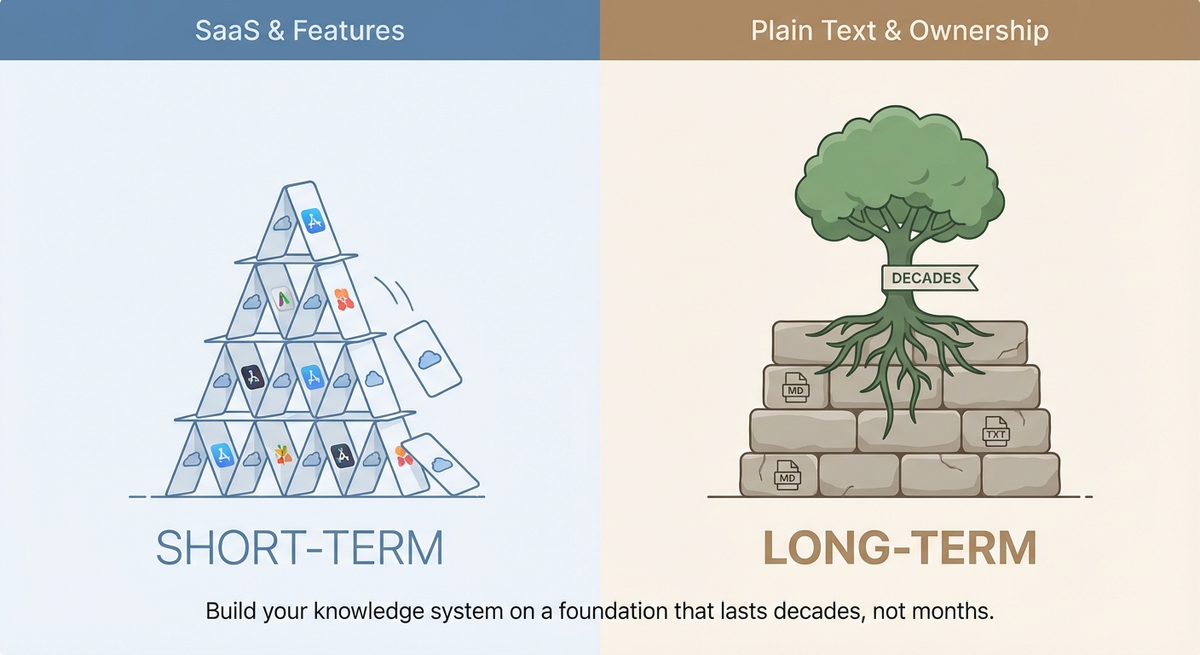
Most people build their knowledge systems for today. Smart people build them for decades. Here's why that choice matters more than you think.
Introduction
Your knowledge base isn't a temporary project. It's your intellectual capital—the essence of your reflections, your worldview, the concepts that have shaped your thinking over years or decades.
This capital deserves the same careful stewardship you'd give to any major life investment. Yet most people make decisions based on short-term convenience rather than long-term viability. If you're going to invest time building a PKM system, you need to build it on principles that last.
They choose the trendy SaaS tool. They love the impressive features. They don't ask the critical question: Will this choice serve me in 10 years?
That question changes everything.
Every decision you make today either empowers your future self or traps them in technical debt they'll spend years escaping. You're either building a foundation that compounds over decades, or you're building on quicksand.
Let me show you how to think long-term about something that matters.
The SaaS Problem: Convenience With Strings Attached
When you build your knowledge base on a SaaS platform, you're not just choosing a tool—you're placing multiple bets with years of your knowledge:
- The company will stay in business
- They won't change their pricing dramatically
- They won't remove features you depend on
- Their priorities will align with your needs
That's a lot of bets to make.
Here's what nobody tells you: most SaaS companies' objectives aren't aligned with yours. They need growth, investor returns, and increasing revenue. You need stability, data ownership, and long-term accessibility. They add features to justify price increases. You need simplicity that lasts.
This fundamental misalignment means that every "improvement" they make might actually harm your long-term interests.
There's also a cruel trade-off at play: the more features a tool adds, the less portable your notes become. Those beautiful databases, those convenient automations, those impressive AI integrations—each one is another chain binding you to that specific platform.
What Actually Happens
You build an intricate system over years. You invest hundreds of hours perfecting your workflows. Then:
- Pricing changes force you to pay up or leave
- Features you depend on get removed in a "redesign"
- The company pivots, gets acquired, or shuts down
- Export works technically but your structure is gone
Your database relationships? Text blocks. Your nested views? Broken. Your carefully crafted connections? Lost. You haven't lost your notes, but you've lost the system. And rebuilding takes months.
The reality: You're renting space in someone else's system. When they change the terms, you're stuck. This is why avoiding vendor lock-in is critical for any system you plan to use for decades.
Data ownership trumps convenience when building systems for life
💡 Learn to evaluate tools properly: My guide to choosing PKM tools walks you through evaluating options for long-term viability. Learn to spot red flags before committing years of knowledge to the wrong platform.
Why Your Data Format Matters More Than Your App
Proprietary formats are like writing your notes in a language only one company can read. When that company changes the language or stops translating, your notes become digital artifacts you can't access.
This isn't theoretical. OneNote formats change. Evernote exports break. Roam's JSON is unusable elsewhere. Even when export "works," you often lose structure, metadata, and connections.
Worse? You don't discover this until years later when you actually need to migrate. By then, you have thousands of notes trapped in a format nobody else can properly read.
Open Formats Are Future-Proof
Plain text and Markdown are different. They're not controlled by any company. Thousands of tools can read them today. Thousands more will read them in 20 years.
They're not perfect. But they're readable. And readable means recoverable.
This is precisely why I built the Obsidian Starter Kit on top of Obsidian; a tool that respects the File over app principle. Your notes live as plain Markdown files on your computer. If Obsidian disappeared tomorrow, you'd still have every note, readable in any text editor. That's real freedom.
If you can't open your notes in a simple text editor, you don't really own them.
Data Portability Is Your Insurance Policy
Data portability isn't just a nice-to-have feature. It's your insurance policy against every possible future problem. It's what separates building on solid ground from building on quicksand.
When your data is truly portable:
- You can switch tools whenever you want, not just when forced to
- You're never at the mercy of a company's business decisions
- Migration is an afternoon project, not a months-long crisis
- Your knowledge survives any tool, platform, or company failure
This is why the format you choose matters more than the app you use. Apps come and go. Companies change direction. But your data outlasts everything if it's in open, portable formats.
How You Use Tools Matters
Here's the irony: People worry about tools being closed-source while creating their own lock-in through how they use those tools.
Take Obsidian. The app stores notes as plain Markdown. It's perfectly portable. But fill those notes with elaborate plugin-specific syntax, custom queries, and tool-dependent automation, and you've built your own prison.
Maybe 30% of your content is now Dataview queries, custom callouts, or plugin-specific code blocks. Move to another tool? All that becomes gibberish.
This is what I call the over-engineering trap: spending more time perfecting the system than actually using it for thinking and creating. The technical elegance of your setup becomes the goal instead of the means. You mistake the container for the content.
That's exactly why I've built the Dataview Serializer plugin for Obsidian plugin: to ensure my data is not only available via one tool.
Use Power Features Strategically
The question isn't whether to use powerful features. It's whether to use them strategically, understanding exactly what you're trading.
Every Tool for Thought has extensions that add lock-in:
- Notion databases
- Roam block references
- Obsidian plugin-specific syntax
- Custom workflows that depend on specific tools
- ...
Use them if the value justifies the risk. But keep your core content portable. Don't let convenience features trap years of knowledge. True data portability means your notes remain (mostly!) usable even when stripped of all the fancy features.
Values Before Features: The Foundation of Long-Term Thinking
This is where most people get it backwards: they choose tools based on impressive feature lists and marketing pages. They should start with values.
When evaluating any knowledge management tool, the last thing you should look at is the feature list. The first thing you should examine is whether the tool's values align with yours.
Ask yourself:
- Will my notes still be accessible in 20, 30, 40 years?
- Do I truly own my data, or am I renting space in someone else's system?
- Is this company's business model aligned with my long-term interests?
- Are they adding features I need, or features they need to justify price increases?
For me, two values are non-negotiable:
- True data ownership - My notes exist as files I control, in formats that will outlive any single application
- Open formats - Plain text and Markdown that any tool can read, not proprietary formats that trap my knowledge
If a tool doesn't respect these values, it doesn't matter how impressive its features are. I won't trust it with my intellectual capital.
The Framework: How to Evaluate Long-Term Viability
Here's how I evaluate any tool or approach for long-term use:
The 10-Year Test
Ask yourself: If I couldn't use this tool in 10 years, would I still have meaningful access to my knowledge?
If the answer is no, you're building on quicksand.
The Hierarchy of Lock-in Risks
Not all risks are equal. Here's how I rank them (see also: In defense of using fewer tools):
Highest Risk: Platform dependency
- Cloud-only tools where your data lives on someone else's servers
- Proprietary formats that only work with specific software
- Tools where export means losing most of your value
Medium Risk: Format dependency
- Open formats with heavy tool-specific extensions
- Markdown polluted with custom syntax
- Data that's technically portable but practically not
Lowest Risk: Feature dependency
- Local storage with open formats
- Plain text that any tool can read
- Simple structures that degrade gracefully
Start at the bottom and only move up when you're certain the value justifies the risk.
Questions to Ask Before Committing
Before investing significant time in any tool or workflow, ask:
- Where does my data live? Local storage gives you control. Cloud-only puts you at mercy of business decisions.
- Can I read my data without this tool? If you need special software to open your files, you have a problem waiting to happen.
- What happens if this tool disappears? Companies die. Products get abandoned. Apps change direction. Plan for it.
- How easy is migration? Try exporting a subset of your notes and importing them elsewhere. If it's painful with 100 notes, imagine it with 10,000.
- Am I creating tool-specific dependencies? Every custom syntax block, proprietary feature, or tool-specific workflow is a potential migration headache.
- Does this choice align with the File over app principle? Your data should outlive any app.
Building in Graceful Degradation
The best systems don't break when tools change—they degrade gracefully.
This means:
- Your core knowledge remains accessible even without advanced features
- Links still work (or can be easily fixed)
- Structure remains understandable
- Value persists even if automation disappears
Think of it like building a house. The foundation and walls should stand even if you remove the fancy smart home features.
🎯 Ready to build on solid foundations? The Obsidian Starter Kit gives you a complete, battle-tested system built on these exact principles. It's designed for decades of use with Obsidian, following the File over app principle. Your knowledge stays portable, accessible, and yours—forever. Get the Obsidian Starter Kit →
📚 Deep dive: My Knowledge Management for Beginners course covers these principles in detail, showing you exactly how to build systems that last. You'll learn not just what tools to use, but how to think about knowledge management for the long term. Start the course →

The Mindset Shift
The real difference between building for months and building for decades isn't technical—it's psychological.
- Building for months means asking: "What's convenient right now?"
- Building for decades means asking: "What serves my future self?"
It's the difference between renting and owning. When you rent your knowledge base from a SaaS provider, convenience is great until the landlord raises rent or sells the building. When you own your knowledge base through local storage and open formats, you have freedom—and responsibility.
Most people don't want that responsibility. They want tools to "just work" without thinking about data formats, backup strategies, or portability. I understand that. Convenience is seductive.
But convenience is expensive when you pay the price in lost knowledge, wasted migration time, and feeling trapped by past choices.
As I always say: Data ownership trumps convenience when building systems for life.
The AI Integration Question
Everyone wants to add AI to their knowledge system. Most are doing it wrong.
It's perfectly OK to use AI. And it's understandable that you want an app that integrates direct support for AI or enables you to use your own. But...
What's not okay is replacing your own thinking. Let me repeat that: writing your notes is thinking. When AI writes your notes for you, you're outsourcing the very activity that builds understanding and memory. The writing is the point.
Also, consider the case of Obsidian. Out of the box it has ZERO support for AI. Is it a problem? Absolutely not. Why? Because it's all just Markdown files on your computer, and it means that you can actually point ANY AI at your knowledge base and it just works. Now compare that with a SaaS like Tana that natively integrates AI support. Yes it provides AI support, but on their terms, with their own way of seeing things, with their own feature set. With Tana, you can only use the AIs they enable you to use. It's a VERY different value proposition.
Putting It All Together
If you're realizing your current system isn't built for the long term, don't panic. You don't have to rebuild everything overnight.
Start by auditing your current setup against the framework above. Identify your biggest risks. Then address them one at a time.
Ready to Build a System That Lasts Decades?
I've created comprehensive resources to help you build knowledge systems the right way:
📚 Knowledge Management for Beginners - Master the Principles
Understanding WHY matters as much as knowing HOW. This comprehensive course teaches you:
- How to evaluate tools for long-term viability
- The File over app principle and why it protects your knowledge
- Strategic thinking about PKM systems
- How to avoid common traps and pitfalls
- Frameworks for making decisions you won't regret
Start the Knowledge Management for Beginners course →
🎯 Obsidian Starter Kit - Your Complete PKM Foundation
Stop reinventing the wheel. Get a battle-tested system built on long-term principles from day one. The OSK gives you:
- A complete, ready-to-use Obsidian vault designed for decades of use
- Pre-configured systems following the File over app principle
- Strategic plugin selection that maintains portability
- Templates, workflows, and best practices from 25+ years of knowledge management
This is the system I wish I'd had when I started. It saves you years of trial and error.
Get the Obsidian Starter Kit →
🚀 Knowledge Worker Kit - Go Beyond PKM
Once your knowledge system is solid, level up your entire productivity system. The Knowledge Worker Kit covers various topics such as Personal Knowledge Management (PKM), Personal Organization, Focus, Time Management, Project Management, Productivity, Priotirization, and everything you need to thrive as a modern knowledge worker.
Explore the Knowledge Worker Kit →
Remember: You're building infrastructure for your thinking. That deserves the same long-term planning you'd give to any important life investment.
Conclusion
The knowledge you're building today—will it serve you in 2035? Will your future self thank you for thinking ahead, or curse you for chasing convenience?
Most people will keep chasing the newest tool, the prettiest interface, the most impressive features (i.e., they suffer from the Shiny object syndrome). They'll rebuild their systems every few years (at best), each time losing a bit more of what they'd carefully constructed.
Smart people will ask different questions. They'll think in decades. They'll choose data ownership over convenience. They'll build on foundations that can support a lifetime of knowledge.
The difference between these paths isn't technical skill or resources. It's simply taking the time to think long-term about something that matters.
And here's what you need to understand: the ROI of PKM isn't immediate. When you start, your system has little value. You don't know what to capture, how to organize, how to connect ideas. It feels like work without payoff. Many people give up here. But those who persist reach a critical mass where the system starts creating real leverage. The connections multiply. The insights compound. The value grows exponentially. This doesn't happen in weeks. It happens over months and years. But it does happen, if you build on principles that last.
Your knowledge base is too important to build on quicksand. Give it the solid foundation it deserves.
Start building for decades, not months.
That's it for today! ✨
Go Further
 Sébastien Dubois
 Sébastien Dubois
 Sébastien Dubois
Want to go deeper?
Sébastien Dubois
About Sébastien
Ready to get to the next level?
Found this valuable? Share it with someone who needs it.