Creative Momentum - Why Most Creators Fail Before They Even Start
Your knowledge system is the difference between consistent creation and creative paralysis. Discover how a Personal Knowledge Management system protects creative momentum by eliminating the friction that kills consistent output

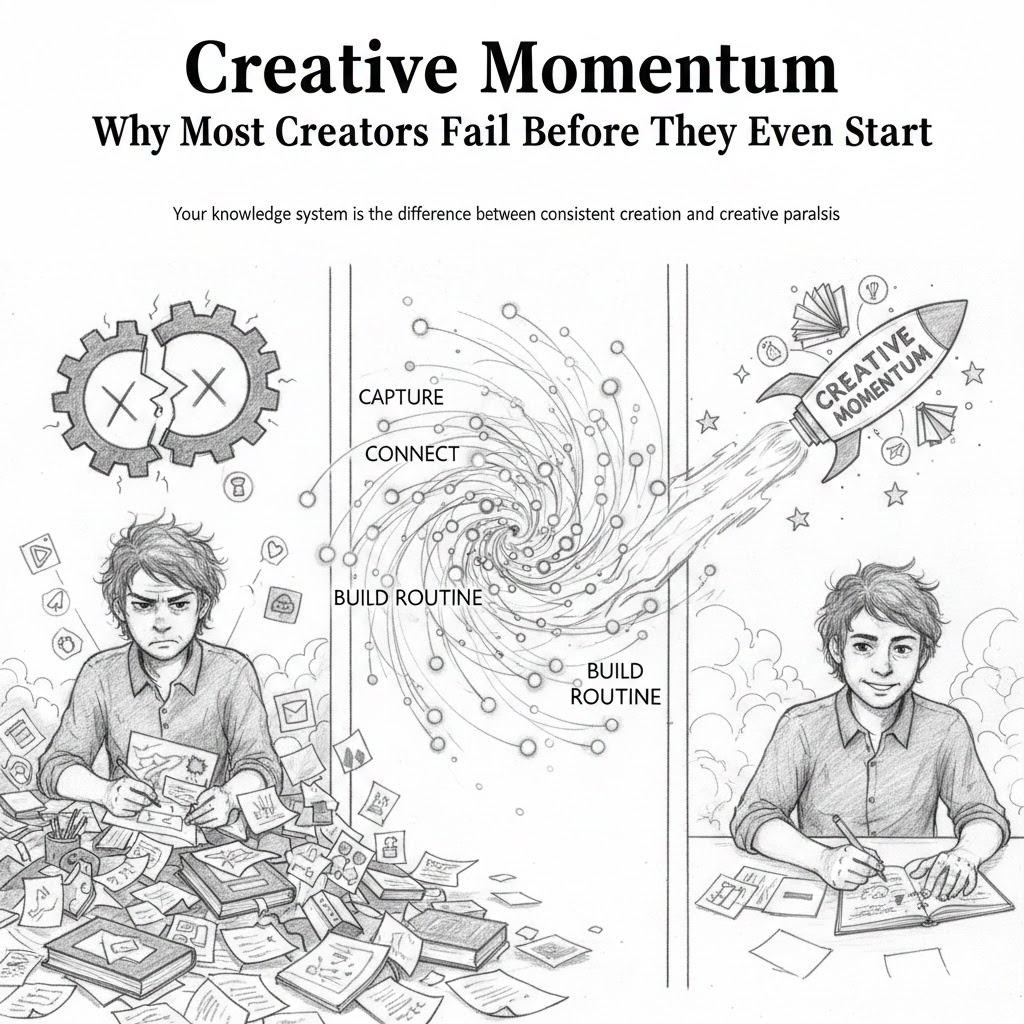
Your knowledge system is the difference between consistent creation and creative paralysis
You've experienced this: You publish a great piece of content. Ideas are flowing. Creation feels effortless. Then life happens. You take a break. A few days turn into a week. When you finally sit down to create again, it feels like pushing a boulder uphill.
In this article, I want to help you understand creative momentum and show you how a Personal Knowledge Management (PKM) system protects you from ever losing it again.
Introduction
Most creators fail not because they lack talent, ideas, or dedication. They fail because they lose creative momentum and never recover.
Creative momentum is the principle that creativity builds on itself. Once you start creating consistently, it becomes progressively easier to continue. But the reverse is equally true: extended breaks make restarting exponentially more difficult.
Inspiration won't save you. Motivation won't save you. Willpower won't save you. But a well-designed knowledge management system will.
Why does this matter? Because consistency and systems matter a lot more than "genius". The creators who win aren't necessarily the most talented. They're the ones who show up repeatedly and ship work without waiting for perfect conditions. This is precisely you need a knowledge system. Not just to remember (although it's a huge benefit too), but to create a foundation for sustained creative output.
In this article, I'll share important ideas about creative momentum: why it is fragile, what destroys it, and how building a Personal Knowledge Management System (PKMS) creates the conditions for sustained creative output without burnout.
TL;DR
Creative momentum dies from three silent killers: waiting for inspiration (rarely comes out of the blue!), perfectionism, and scattered tools. A PKM system protects momentum by capturing ideas in one place, making it easier to connect ideas, to generate new insights, ... Such a system transforms your past work into reusable building blocks, and helps you build consistent routines that enable Deep work and serendipity.
Key points:
- Creative momentum is easier to maintain than rebuild
- Inspiration is overrated, while systems are underrated
- Information silos and tool proliferation destroy creative flow through context switching, friction, and through the difficulty to connect the dots
- Friction points in your processes kill momentum before you notice
- With a Knowledge system, your creations compound over time, making creation easier and easier
- PKM shifts you from passive consumer to active creator. You start collecting valuable ideas and insights like Pokemon, and you can then assemble those and create new ones with ease
- Networked notes create a feedback loop between learning and creating
- Start simple or you'll never start at all
What Destroys Creative Momentum: The 3 Silent Killers
Killer #1: Waiting for Inspiration
Most creators treat inspiration like a required ingredient for creation. It's not. It's a luxury that successful creators can't afford to depend on.
When you wait for inspiration, you're training your brain that creation is optional. You're building the habit of inconsistency. Each day you skip reinforces the neural pathway that says "I only create when I feel like it."
In fact, inspiration follows action, not the other way around. Momentum creates inspiration. The act of showing up, and starting to work generates the creative energy you thought you needed before beginning. Also, the system you develop and the associated processes matter a lot more than inspiration.
And this applies to everything you do, be it writing, coding, producing videos, ...
Action is key.
Killer #2: Perfectionism That Prevents Publishing
Most creators fail because they optimize for quality over consistency. They dread the "Publish" button. They push back, refine their creations in never-ending cycles, trying to reach something that will forever elude them: perfection (hint: it doesn't exist).
You think you're being professional by endlessly refining your work. Really, you're protecting yourself from the vulnerability of shipping. Every hour spent polishing is an hour not spent creating the next thing.
Perfectionism breaks creative momentum in at least two ways. First, it extends the time between publishing, creating gaps that destroy your rhythm. Second, it trains you to associate creation with pain and endless revision rather than flow and completion, which turns the entire creative act into a chore.
The creators who build sustainable practices understand that shipping "good enough" work consistently beats waiting to create "perfect" pieces by a long shot. Quality improves through volume, feedback and iteration; not through internal revision cycles. When you Focus on creating a library, not just a few pieces of content, you shift from perfectionism to productive iteration.
Killer #3: Tool Proliferation and Context Switching
Every time you switch between apps to find something, you're context switching. Every time you wonder "where did I save that?", you're losing momentum. Every time you spend time and energy deciding which tool to use, you're depleting the creative reserves needed for actual creation.
Some people seem to think that if they're using many tools, it means they're serious about their craft. But I've argued many times In defense of using fewer tools. The fewer tools you can get away with, the better. Fewer tools means fewer headaches, less context switching, less time wasted, and more energy for the work that really matters.
Scattered tools create the illusion of progress while actually destroying the very momentum you're trying to build. You feel productive organizing five different apps. You're actually creating dozens of tiny friction points that make starting each session harder.
It isn't about finding the "perfect" tool (hint: that doesn't exist either). It's about consolidating into one trusted system that eliminates waste (think Lean manufacturing) and protects your creative flow.
That's why You need a capture system. A reliable place where your ideas go and where you know you can find them again with ease.
How to Maintain Creative Momentum: 4 Knowledge Management Mechanisms
A Personal Knowledge Management system doesn't just organize information. It fundamentally transforms how you create by establishing four critical momentum mechanisms.
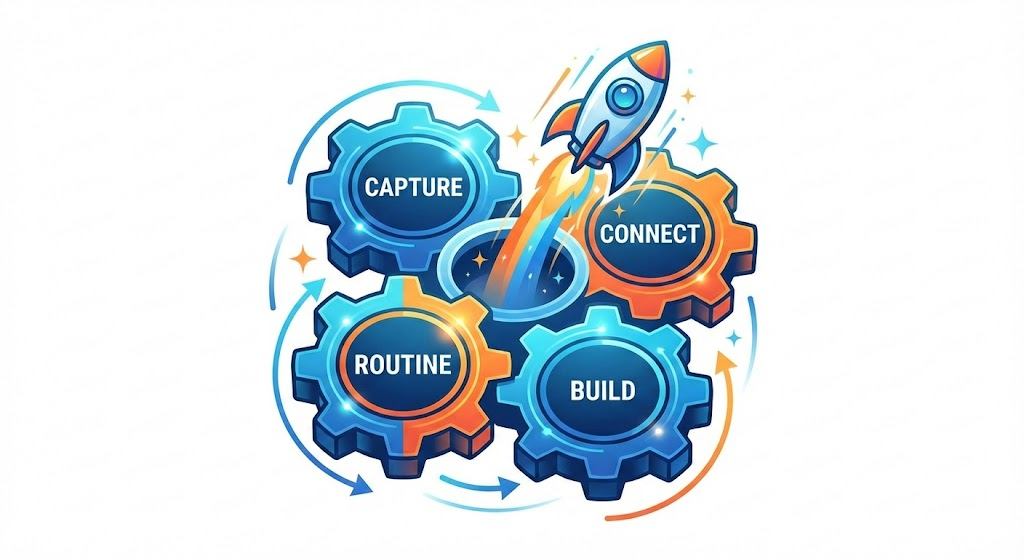
Mechanism 1: Idea Capture Eliminates Creative Anxiety
The fear of losing insights creates anxiety that drains creative energy. When interesting ideas have nowhere reliable to go, your brain tries to hold onto them. But the brain is not reliable. Many valuable ideas get lost forever that way.
Unfortunately, Many people forget or neglect to take notes, treating insights as disposable rather than as valuable assets. Not everyone agrees with this take, but I believe that it's a mistake that compounds over time. Not that you need to capture everything, but you should definitely have a trusted system where you can safely store ideas that have potential.
A trusted capture system makes it straightforward and effortless. Whenever I stumble upon something that resonates and that I find valuable/useful/actionable in the short term, I take notes, I capture relevant sources and content, and connect the ideas to the ones I already have in my system. The moment I capture an idea, my brain releases it. That mental space becomes available for creative thinking instead of anxious remembering.
If you're wondering What a capture system looks like in practice, it's simpler than you think: a single place where all ideas go, with minimal friction between thought and capture. For more on why this matters so much, read Stop Losing Your Best Ideas - The Journaling System That Changed My Life (Article). The principles apply to all forms of creative capture, not just journaling. Also check out my other articles about Knowledge Management; I've published many pieces about that topic already.
Beyond reducing anxiety, knowing you have a rich vault of captured ideas eliminates blank page paralysis. You're never starting from zero. You're always building on something. And over time, it all compounds.
Mechanism 2: Connected Notes Generate Ideas Automatically
A key point is that over time, networked notes (i.e., what you get when you centralize and connect notes together in a single system) create compound creative growth.
In a (well-designed) Knowledge Management system, every note links to related concepts (cfr How to connect ideas). When you review any note, you automatically surface connected ideas you might have forgotten about. These unexpected connections are the raw material of creativity.
Whenever I want to create something new, I just have to dive into my notes and I will be able to resurface many connected ideas, making it quite easy to follow a trail and tell a compelling story, referencing many different ideas, even from entirely different (e.g., writing, software architecture, personal development, ...). This is the essence of How to create new content using your existing notes: leveraging connections to generate new insights rather than creating from scratch every single time.
It's the compound effect of consistent linking over time. Each new note you create doesn't just add value; it multiplies the creative potential of every existing note through new possible connections.
Your knowledge base becomes exponentially more valuable as it grows. This creates a Virtuous circle: the more you capture and connect, the easier creation becomes, which motivates more capturing and connecting.
By the way, this is actually the "secret" of many popular online writers. They have solid knowledge systems they rely on to reuse, combine and transform old ideas to create new ones. Some examples: Dan Koe, David Perell, Shane Parrish, Tim Denning, and many others.
Mechanism 3: Past Work Becomes Reusable Building Blocks
Most creators suffer from "starting from scratch" syndrome. Every new piece feels like climbing a mountain.
A Knowledge Management system transforms everything you've ever created into modular building blocks. That article you wrote six months ago? It was based on a set of Atomic notes that you've assembled, but that can be recombined with other ideas in new contexts. That research you did last year? It's connected to current interests, ready to be reused.
This is why you should Focus on creating a library, not just a few pieces of content. Every piece you create feeds your library, making future creation progressively easier. You're not just publishing: you're building creative infrastructure. That's what people such as Tiago Forte call a "Second Brain".
This dramatically lowers the energy required to start new projects and create new things. You're not facing a blank page. You're just doing shopping, exploring your past ideas and insights, and assembling existing pieces in novel ways. Learn more about this approach in How to create new content using your existing notes.
Beyond that, this approach creates a Positive feedback loop between creating and learning. When you publish content from your notes, the process of transforming private notes into public content generates valuable new insights. These insights flow back into your system, enriching the knowledge graph and making future creation even easier. Another Virtuous circle.
Mechanism 4: Consistent Routines Eliminate Decision Fatigue
Here's what kills momentum for most creators: every session begins with a series of decisions. What should I create? Where should I start? Which sources should I reference? What format should I use?
Each decision depletes willpower before you've written a single word.
A well-designed Creation system built on top of a solid Knowledge Management system with consistent workflows eliminates these momentum-killing decisions.
You don't wonder what to create. Instead, you review your notes and connections suggest directions. You don't wonder where to start. You have a system. And your system has got you covered; "it" knows what you need to do next.
The mental energy other creators waste on decision-making? You invest it in actual creation. For more on developing these core capabilities, explore the Knowledge Management Proficiency Ladder to understand where you are and where you're heading. But consider that this ladder just corresponds to one of the foundational elements you need if you're serious about building a strong creative practice. In addition to a solid Knowledge Management system, you need what I like to call a "Creation System". That's a (solid) system that you rely on for your creative endeavors. The Knowledge Management system is at its very core, but it also needs to include other parts, such as a publishing system, clear processes, habits, and more!

This is a topic that I intend to write a lot more about. One of my major goals this year is actually to turn my own system into a blueprint that can be shared and reused with others. If you're interested, then subscribe to my newsletter, and consider joining the Knowii Community, where I'm sharing tons of details about all this.

How to Build Creative Momentum as a Creator: The Identity Shift
One of the most valuable aspects of PKM for building creative momentum is something very few people talk about: it helps you to shift from passive consumption to active creation.
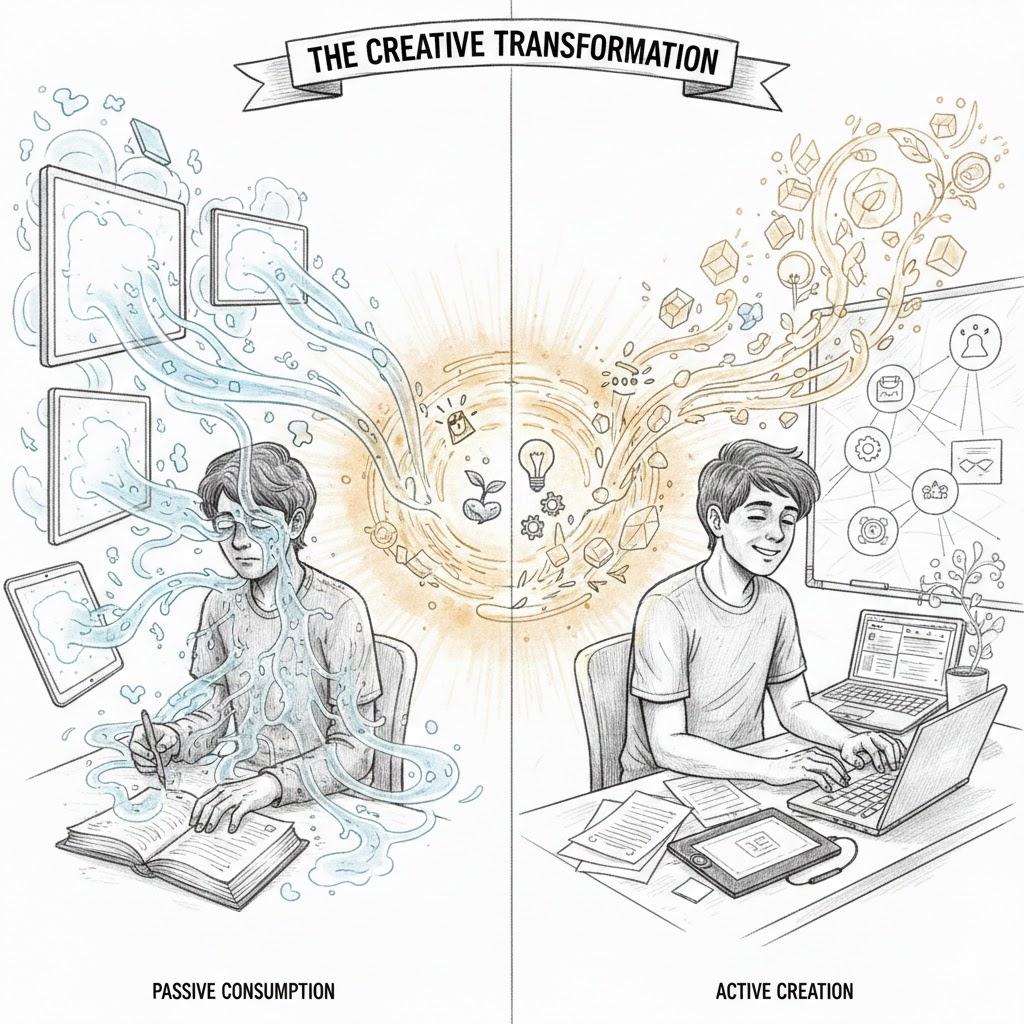
Without a system, you consume information endlessly. Articles, books, videos, courses. It inspires you, but it all flows through you and disappears. You're a "mere consumer".
The moment you start capturing, processing, and connecting ideas, that changes. You can't truly add something to your knowledge base without thinking about it (unless you're using AI wrong!). You can't link new concepts to existing ones without thinking more deeply about the ideas.
This transforms consumption into creation. Reading becomes idea generation. Learning becomes content development. Your Knowledge Management system makes passive consumption feel fruitless, naturally pushing you toward a more active & engaged stance.
A solid Knowledge system doesn't just organize knowledge. It's a foundation that reinforces the creator identity and sustains momentum.
Common Objections About Creative Momentum and PKM Systems
"But doesn't everyone need rest?"
Yes. But let's be clear about what we're discussing.
There's a fundamental difference between strategic rest within a sustainable system and the extended breaks that destroy momentum. Rest doesn't mean stopping creation for weeks. It means building sustainable daily practices that don't require heroic effort.
The creators who burn out aren't the ones with consistent systems and positive habits. They're the ones who rely on unsustainable hustle because they lack systems. They work harder because they start from scratch every time.
Solid creation and knowledge systems make creation less effortful, not more. The rest you need becomes manageable within your routine, not a momentum-destroying gap.
"What if my PKM system becomes procrastination?"
Some people fall into the trap of endless note-taking and organizing without ever creating. They're building an elaborate system they never actually use for its intended purpose.
The solution isn't to avoid Knowledge Management. It's to maintain focus on what matters: leveraging the knowledge, ideas and insights, turning it all into wisdom (i.e., knowledge turned to action). Your notes exist to serve your creative work, not replace it. Taking notes is not the goal. Creating and sharing ideas is.
Keep in mind that if you're spending more time organizing notes than publishing content, you've lost the plot. The measure of a good knowledge system isn't how organized it is; some level of chaos is actually great for creativity. The real measure is how much it reduces the friction of creating and shipping work.
Check out the following article to learn more about some of the pitfalls to avoid: 12 Common Personal Knowledge Management Mistakes and How to Avoid Them (Article)
 Sebastien Dubois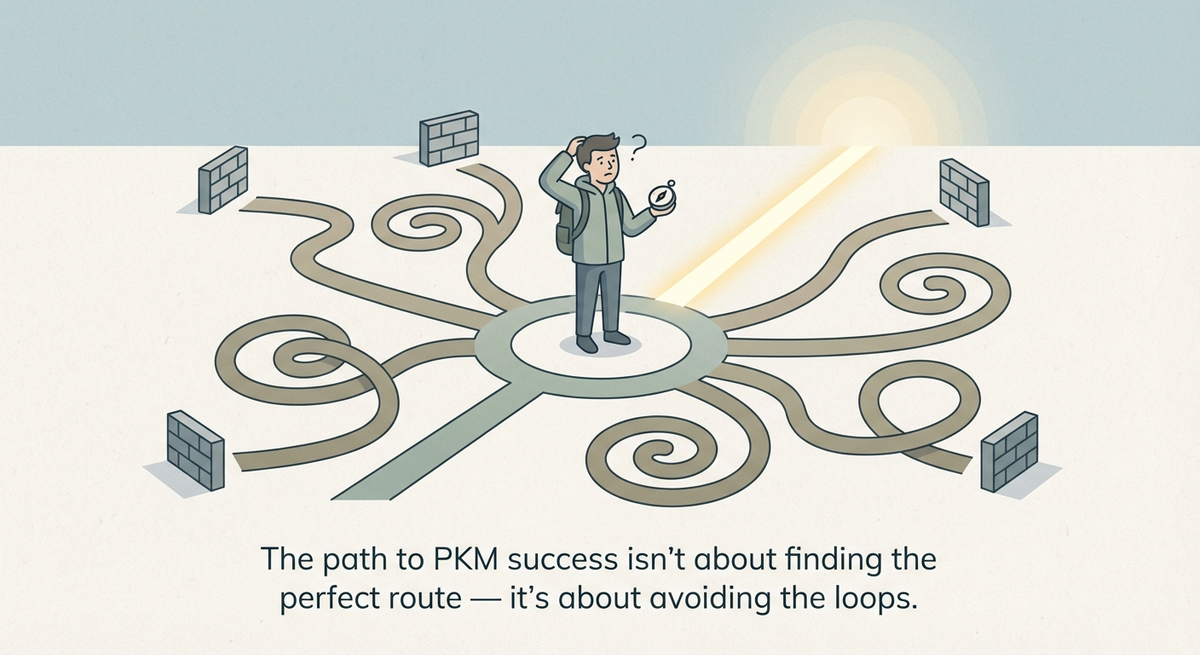
"This sounds like a lot of work upfront"
It is. But so is repeatedly starting from scratch because you lack momentum.
You're going to invest time either way. You can invest it upfront building a system that compounds, or you can invest it repeatedly overcoming inertia because you have no system, and end up burned out.
Note that you don't need to build the "perfect" system before seeing benefits. Start simple. Create a single trusted place to capture ideas. Build the habit of linking related concepts. Ship work regularly from your notes. Interstitial Journaling and daily notes in particular is a great starting point for your knowledge management journey.
Understanding the Knowledge Management Proficiency Ladder helps. You don't need to be an expert to benefit from PKM. Even beginners who simply capture and occasionally review their notes see momentum improvements.
The first step is just starting, even if it's messy and imperfect. It's still progress.
How to Recover Creative Momentum After a Break
Momentum will break sometimes. Life happens. You'll slow down to a crawl, or you'll stop creating entirely for a while. The question isn't whether you'll lose momentum, but rather how quickly you can rebuild it.
Here's what works:
Step 1: Lower the bar temporarily. Don't try to resume at full intensity. Start with embarrassingly small actions. Open your notes. Read one entry. Link one idea. Publish one short piece, or even short social media posts. Small actions rebuild the neural pathways of consistent creation.
Step 2: Focus on process, not output. When you resume creating, the goal is not to produce your best work, the to reestablish the habit of showing up and creating. Quality returns naturally once the habit and rhythm are restored.
Step 3: Use public accountability. Share that you're rebuilding momentum. Build in public. The social commitment creates external structure when internal motivation is weak.
Step 4: Reconnect with your why. Review past work. Remember why you started creating. Your knowledge system holds the evidence of your previous momentum. Use it to reignite the fire.
The creators who sustain long-term success aren't the ones who never lose momentum. They're the ones who rebuild it quickly when it breaks.
How to Start Building Creative Momentum Today: 5 Practical Steps
If you're reading this and feeling overwhelmed, start here:
Step 1: Choose one trusted system for all your notes. Stop tool-hopping. Pick a single place for your notes. I strongly believe that Obsidian is the best choice for creators building for the long term (reasons: Why Obsidian is All You Need - From Simple Notes to Complete Productivity (Article)), but the most important thing is choosing something and committing to it. Your goal is to create a Single Source of Truth (SSOT) for your creative work.
Step 2: Build the capture habit. For the next week, just capture ideas as they come. Don't worry about organization. Don't worry about perfection. Train your brain that interesting ideas go into your system. If you need concrete guidance, review What a capture system looks like to learn more.
Step 3: Start linking related ideas. When you capture something new, ask: "What does this connect to?" Link it to one related note. Just one. This builds the habit of thinking in connections. Check this other article to learn more: How to connect ideas.
Step 4: Create and publish from your notes (Week 3). Pick one idea in your system. Elaborate on it. Publish it. Don't overthink it. Don't aim for perfection. Hit "Publish" sooner than you're comfortable to. Experience the reduced friction of creating from existing material rather than from scratch.
Step 5: Repeat daily and maintain consistency (Ongoing). Momentum isn't built through intensity. It's built through consistency. Show up every day, even if just for 15 minutes. Trust the compound effect. Each day's work feeds into the next, creating exponential growth over time.
That's it. You don't need a complex system. You don't need advanced techniques. You need to start simple and maintain consistency. The rest can come later.
Common Questions About Creative Momentum
What is creative momentum?
Creative momentum is the principle that creativity builds on itself. Once you start creating consistently, it becomes progressively easier to continue.
Inspiration follows action, not the other way around. Momentum creates inspiration
Regular creative practice maintains a generative mental state, completed work inspires subsequent ideas, and resistance-overcoming becomes an established habit. The reverse is equally true: extended breaks from creating make restarting progressively more difficult.
Why do I lose creative momentum so easily?
Creative momentum is fragile because it depends on neural pathways that weaken quickly without use. Even a 3-5 day gap can make restarting feel significantly harder. The primary momentum killers are: waiting for inspiration instead of creating on schedule, perfectionism that prevents publishing, context switching between scattered tools, and lack of systems to reduce decision fatigue. This is exactly why You need a capture system and a larger Knowledge Management system. It protects against the most common momentum destroyer: forgetting ideas and losing creative material.
How do I maintain creative momentum without burning out?
Sustainable creative momentum comes from consistent small actions, not heroic effort. Building a Knowledge Management system helps a ton.
Also, focus on shipping "good enough" work regularly rather than perfect pieces occasionally.
Importantly, create daily routines that eliminate decision fatigue. Habits make everything easier.
Last but not least, focus on building a sustainable system. It's not about "hard work"; it's about working smart while respecting your body and your mental health, etc. Rest is also key.
What's the fastest way to regain creative momentum after a break?
The fastest recovery strategy is to lower your standards temporarily and focus on tiny actions. Don't try to immediately produce your best work. Instead: (1) Open your notes and read one entry, (2) Link one new idea to existing notes, (3) Write for just 10 minutes without publishing, (4) Publish one short, imperfect piece (even a tweet!), (5) Gradually increase intensity. The goal is rebuilding the habit, not immediate output quality. Your existing notes are your best recovery tool.
How does a PKM system help with creative momentum?
A Personal Knowledge Management System (PKMS) helps maintain creative momentum through four mechanisms: (1) Capturing ideas eliminates the anxiety of forgetting insights, freeing mental space for creation, (2) Connected notes automatically surface related ideas (cfr How to connect ideas), providing constant creative fuel, (3) Past work becomes reusable building blocks, (4) Consistent workflows remove decision fatigue about what to create and how to start.
To understand your current Knowledge Management level and where you're heading, explore the Knowledge Management Proficiency Ladder.
Can you have creative momentum without a Knowledge Management system?
Yes, but it's significantly harder to maintain long-term. Without a PKM system, you rely on memory, inspiration, and willpower: inherently unreliable resources.
You face blank pages more often, waste energy on decision-making, and struggle to build on past work. A solid Personal Knowledge Management system doesn't create momentum — consistent action does — but it dramatically reduces the friction that often kills momentum.
What's the difference between creative momentum and motivation?
Motivation is an emotional state that fluctuates based on mood, circumstances, and external factors. Creative momentum is a systematic practice that generates forward motion regardless of how you feel. Motivation asks "Am I inspired to create today?" while Momentum says "I create today because that's what I do.".
Relying on motivation leads to inconsistency. Building momentum through systems leads to sustainable output.
Progress is the engine of motivation
How often should I create to maintain creative momentum?
Daily creation is ideal for maintaining strong momentum, even if just for 15-30 minutes. Consistency matters more than duration. Creating for 20 minutes daily builds more momentum than creating for 4 hours once a week. Regular small actions maintain the neural pathways and generative mental state that make creation feel effortless. That's why I often say that your knowledge management practice should become an integral part of your work. It's also why I consider Interstitial Journaling to be so valuable.
What should I do when I don't know what to create?
This is where a PKM system becomes invaluable. Instead of staring at a blank page wondering what to create, you: (1) Review recent or old notes and follow interesting connections, (2) Look at ideas you've captured but not developed, (3) Identify patterns or themes emerging in your knowledge base, (4) Combine notes to generate new insights.
Think of your notes as LEGO blocks. You can assemble those in countless ways. Your system provides endless starting points, eliminating the paralysis of choice.
Going Further
If you're new to Knowledge Management and want structured guidance on building a system that protects your creative momentum, I created Knowledge Management for Beginners.

This course walks you through the foundational principles and practical techniques for creating a knowledge system that works for you, not against you. It covers everything you need to know; don't let the name of the course give you the wrong impression. With this course, you'll quickly progress through the Knowledge Management Proficiency Ladder, and you'll finally have a system you can rely on to boost your creative life.
And if you're ready to implement these ideas in Obsidian specifically, the Obsidian Starter Kit gives you a complete, battle-tested vault structure based on years of refinement. It eliminates the overwhelming decisions about how to organize your system, letting you focus on capturing, connecting, and creating.
Both resources are designed to get you building momentum quickly, without the paralysis of trying to create the "perfect" system from scratch.
Regarding full-blown Content Creation systems, I recommend joining the Knowii Community. I'm sharing tons of ideas about that there.
Conclusion
Creative momentum is the compound interest of the creator economy. Small, consistent actions build unstoppable forward motion. But momentum is fragile. It is easily destroyed by waiting for inspiration, perfectionism, hustling, and not capturing/nurturing valuable ideas.
A Personal Knowledge Management system protects momentum by eliminating the friction that kills it. It captures ideas you can build upon. It connects notes to surface insights naturally. It transforms past work into reusable building blocks. It establishes routines that eliminate decision fatigue, so you can use your willpower to create.
Most importantly, it shifts your identity from consumer to creator, making consistent output feel natural rather than forced.
You don't need more talent. You don't need more time. You don't need perfect conditions. You need a system that makes creation easier than procrastination.
Start simple. Start today. Let momentum do the rest.
That's it for today! ✨
About Sébastien
I'm Sébastien Dubois, and I'm on a mission to help knowledge workers escape information overload. After 20+ years in IT and seeing too many brilliant minds drowning in digital chaos, I've decided to help people build systems that actually work. Through the Knowii Community, my courses, products & services and my Website, I share practical and battle-tested systems. You can follow me on X 🐦 and on BlueSky 🦋.
I am an author, founder, and coach. I write books and articles about Knowledge Work, Personal Knowledge Management, Note-taking, Lifelong Learning, Personal Organization, and Zen Productivity. I also craft lovely digital products.
If you want to follow my work, then become a member and join our community.
Ready to get to the next level?
If you're tired of information overwhelm and ready to build a reliable knowledge system:
- 🎯 Join Knowii and get access to my complete knowledge transformation system
- 📚 Take the Course and Master Knowledge Management
- 🚀 Start with a Rock-solid System: the Obsidian Starter Kit
- 🦉 Get Personal Coaching: Work with me 1-on-1
- 🛒 Check out my other products and services. These will give you a rock-solid starting point for your note-taking and Knowledge Management efforts