How to Split Long Notes into Atomic Notes: A Comprehensive Guide

A comprehensive guide on splitting long notes into atomic notes within a Personal Knowledge Management (PKM) system, highlighting the benefits, and practical steps

How to Split Long Notes into Atomic Notes: A Comprehensive Guide
A long note connected to a graph of Atomic notes. Image generated using DALL-E

In this article, I want to share ideas about how to split long notes into atomic ones. This practical guide should help you enhance your Knowledge Management practices.

Introduction

The concept of atomic notes deserves more attention from those seeking to create more valuable notes that optimize their information retention/retrieval processes and enable connecting ideas together (i.e., create valuable Knowledge Graphs).

How to connect ideas together
As you learn and grow, you’ll accumulate more and more knowledge. While each piece is important, the relationships between ideas is, at least, as important as the ideas themselves.

As we'll see, atomic notes are much more interesting than long and linerar ones.

The Downsides of Long Notes in Personal Knowledge Management Systems

While long notes are sometimes useful or unavoidable, their drawbacks in the context of Personal Knowledge Management (PKM) systems are clear. They hinder quick retrieval, contribute to cognitive overload, impede the creation of a connected knowledge network, limit the system's flexibility, and are less suitable for sharing.

PKM systems are designed to enhance the way we capture, organize, retrieve, and use knowledge. The ultimate goal is to create a dynamic ecosystem of information that supports learning, decision-making, and creativity. However, incorporating long notes into a PKM system can introduce several challenges that may compromise its usefulness, effectiveness and efficiency.

Here are some of those challenges:

1. Makes it harder to retrieve information

Long notes, by nature, tend to contain multiple ideas, insights, and pieces of information clustered together and intertwined. This density can make it difficult to quickly find specific pieces of information when they're needed.

2. Leads to Cognitive Overload

A core principle of effective PKM is minimizing cognitive overload by organizing information in a way that aligns with how our brains naturally process and retrieve data.

Long notes, with their complex and often convoluted structures, can quickly become overwhelming. They make it much harder to absorb and recall information. This is counterproductive to the learning and creative processes that PKM systems aim to support.

3. Impedes Linking and Connectivity

One of the strengths of a robust PKM system is the ability to create connections between different pieces of knowledge. Long notes make it challenging to establish these links because they blur the lines between distinct ideas, making it hard to see how they relate to other concepts within the system.

Atomic notes, on the other hand, facilitate creating a network of interconnected ideas, enhancing understanding and discovery.

4. Limits Flexibility and Adaptability

While long notes and documents are generally able to express complex ideas in a linear way, they're far from ideal.

PKM systems thrive on flexibility and the ability to evolve over time. Long notes are static and rigid. They don't easily allow for the addition, modification, or reorganization of information. This rigidity can stifle the growth of your knowledge base and limit its adaptability to new insights or changing needs.

Isn't there a way to take Smarter Notes?

At this point, we can probably agree that long notes and documents are far from ideal from a Knowledge Management perspective. Still, it's all we get taught. At school we're only taught the basics of linear note-taking, writing essays and summarizing information. It's no wonder that the default for most people is to reuse the same approaches throughout their lives...

But there really is a better way. Taking smart notes consists in going from linear notes that explore ideas in the form of chapters, sections, subsections and paragraphs to atomic/networked notes. Atomic are short and focused notes that each explore specific topics/ideas and are connected to each other. Atomic/networked notes form a network of notes, also known as a Knowledge Graph (KG).
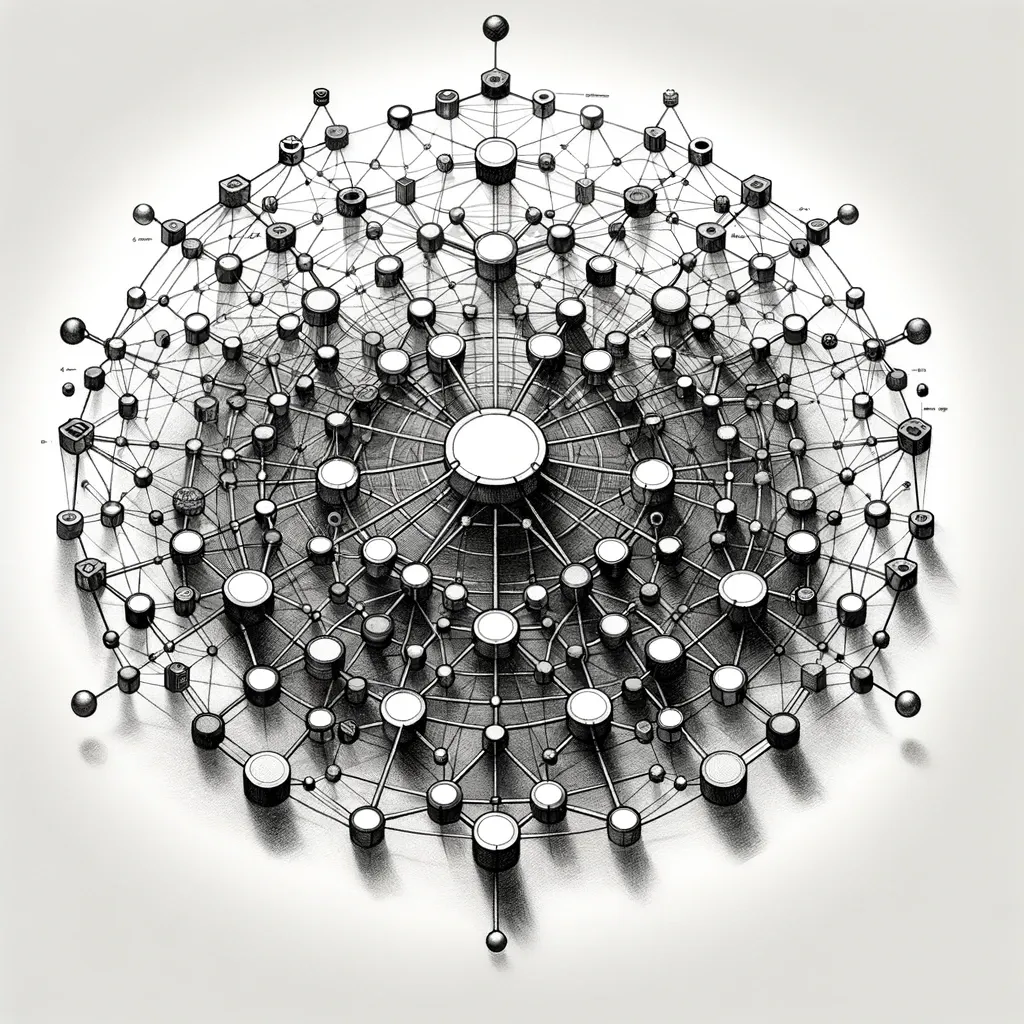
Representation of a Knowledge Graph (KG). Image generated using DALL-E

You might be puzzled about how to create and navigate such a graph. Well, my goal is to help you better understand how to create yours, and how to leverage it.

By the way, Sönke Ahrens has written a fantastic book called How to Take Smart Notes, explaining these ideas, among others. I strongly recommend you to give it a read:

Amazon.com: How to Take Smart Notes: One Simple Technique to Boost Writing, Learning and Thinking eBook : Ahrens, Sönke: Kindle Store
How to Take Smart Notes: One Simple Technique to Boost Writing, Learning and Thinking - Kindle edition by Ahrens, Sönke. Download it once and read it on your Kindle device, PC, phones or tablets. Use features like bookmarks, note taking and highlighting while reading How to Take Smart Notes: One Simple Technique to Boost Writing, Learning and Thinking.

I just want to clarify one point before we continue: it's not because you create a Knowledge Graph that you can't also create and maintain linear "versions" of the information or notes dedicated to giving a more linear way of exploring it (e.g., Maps of Content).

Understanding Atomic Notes

Atomic notes are specific, concise, self-contained and context-independent pieces of information (i.e., notes).

Creating atomic notes is quite different from traditional linear note-taking. Before diving into the process of creating such notes, it's crucial to grasp their core characteristics:

  • Specificity: Each note should cover a single idea
  • Conciseness: Atomic notes should remain easily "digestible". When an atomic note becomes too long, you should consider splitting it up in smaller (i.e., more atomic) pieces
  • Independence: Notes should be understandable on their own, without needing to refer to other notes.
  • Linkability: Despite their independence, atomic notes intend to easily be connected to related notes in order to build a Knowledge Graph

To learn more, check out my previous article on this topic:

The value of atomic notes
Atomic notes are a key element of PKM success. Here’s why

How to Split Long Notes

Splitting long notes into atomic notes involves several steps. The first idea is that a long note is nothing more than a linear series of "LEGO blocks" that can be separated, rearranged, and connected to each other. Each part can become a separate note, linked to closely or loosely related ones.

1. Identify Core Ideas

Begin by reading through your long note to identify its core ideas or concepts.

Look for natural divisions in the content, such as different topics, subtopics, or themes. Highlight or underline these sections as potential candidates for atomic notes.

2. Create Individual Atomic Notes for Core Ideas

Start by creating atomic notes for each core idea you have identified. Those first notes will explain the ideas from first principles (i.e., complete independence), laying out a solid foundation for the next ones.

Now, repeat the process for all the other ideas. During this first pass, just focus in isolating the ideas and avoiding to cover multiple ideas within a single note.

The title of the notes you create should clearly reflect the specific idea or concept it describes. Be concise yet descriptive enough to understand the note's content at a glance. Think of the note title as a sentence or part of sentence that you might want to include somewhere else.

Check out my article about how to name your notes:

The Art of Note Naming: Keys to Effective Knowledge Management
Unlock the full potential of your Knowledge Management system by mastering the art of crafting clear, concise, and organized note names – the secret to transforming your chaotic digital world into a seamlessly searchable, highly efficient repository of wisdom

3. Refine for Clarity and Independence

Ensure each atomic note is written clearly and contains enough context to be understood independently. This may involve adding brief explanations or definitions that were implied in the original long note but not explicitly stated. If you can't add enough context to clarify, then you might need to further decompose the note, until you get to really specific ideas that you can more easily explain.

One of the powers of atomic notes lies in their interconnectivity. Use your note-taking tool's linking feature to connect related atomic notes. This network of notes not only facilitates navigation but also helps in understanding the relationships between different the different pieces of the puzzle.

Linking is more art than science, but the idea is straightforward: if you think that another note is related to the current one or is at least interesting to mention, then add a link to it.

5. Add Metadata

Take some time to add metadata to each new note you create. I personally use tags a lot. Those help me find what I need more easily, for instance by using combination of tags. Those also enable me to more easily create and maintain Maps of Content (MoCs).

Don't worry too much about the taxonomy you use at the beginning. Just try to reuse existing tags if possible. Some tools such as Obsidian facilitate this.

I've previously shared tips about how to tag your notes:

Why and how to tag notes in your PKM
Tags are a great way to categorize, describe and track your notes. This post will show you how to approach tagging the notes in your PKM

6. Review your notes

After splitting, organizing and adding metadata to your notes, take the time to review those for coherence, clarity, completeness, and redundancy. Make adjustments as needed to ensure each note stands on its own while still contributing to the broader knowledge base.

7. Consider creating a Map of Content (MoC)

Once you're done creating your Knowledge Graph, it may be useful to create a Map of Content to ease your (future self) way into the Knowledge you've just organized.

Maps of Content are useful because they provide yet another way to resurface useful notes in specific contexts. They're also useful tools to think about the "network" as a whole.

Check out my article about MoCs to learn more:

Maps of Content (MoCs) for better Knowledge Graphs
Understand what Maps of Content (MoCs) are in the PKM ecosystem. Discover why they are useful and how they can help strengthen your knowledge graph

Concrete Example

Now that you have the "framework" to use, let's look at a more concrete example based on my own notes.

While reading the book called "Organize Your Mind Organize Your Life" by Paul Hammerness and Margaret Moore, I have created a summary of the things that resonated with me:

That is just the very first part. That note is actually very long. It covers all the chapters of the book. If you look closely at that note, you'll notice that it actually contains a lot of information that I have captured, but also that it includes many links to other notes (links in Obsidian are recognized by the brackets (i.e., "[" and "]") around. While that note is a really long one, it also serves as a Map of Content for the book in my knowledge graph. That's why I keep it around.

While I read books, I tend to create really long notes and then apply the process I've described in this article to extract the ideas that resonated with me into separate atomic notes that I connect to my Knowledge Graph. Once I'm done, the book summary becomes a map of the content I have extracted into a graph of atomic notes.

Let's look at one of the atomic notes that I have extracted from the initial document:

As you can see, I have created an atomic note that shortly discusses the Prefrontal cortex (PFC). That note includes the information I found in the book, and links to other notes in my knowledge graph. The ability to link that concept to others is really where atomic notes shine:
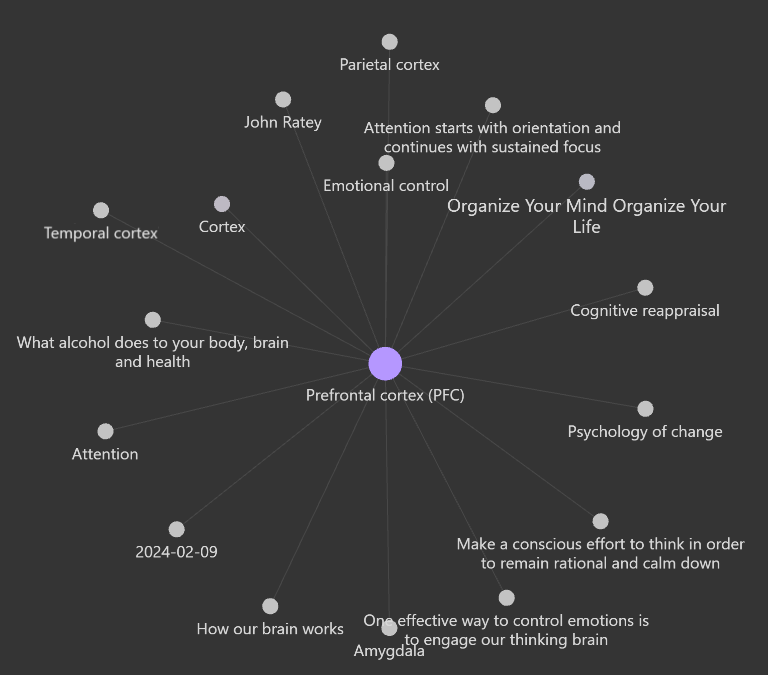
What my note about the Prefrontal cortex links to

Those are the outgoing links of that note. So, after reading that book and extracting atomic notes from my summary, I have connected it with other ideas. And over time, those connections will only increase.

This is just one example, but it should already give you an idea about how I go about it. Within the long note that I keep around, I don't mind duplicating information. I like the idea of the remaining long-form document to still be usable on its own, even though the most important part for me is feeding my Knowledge Graph:
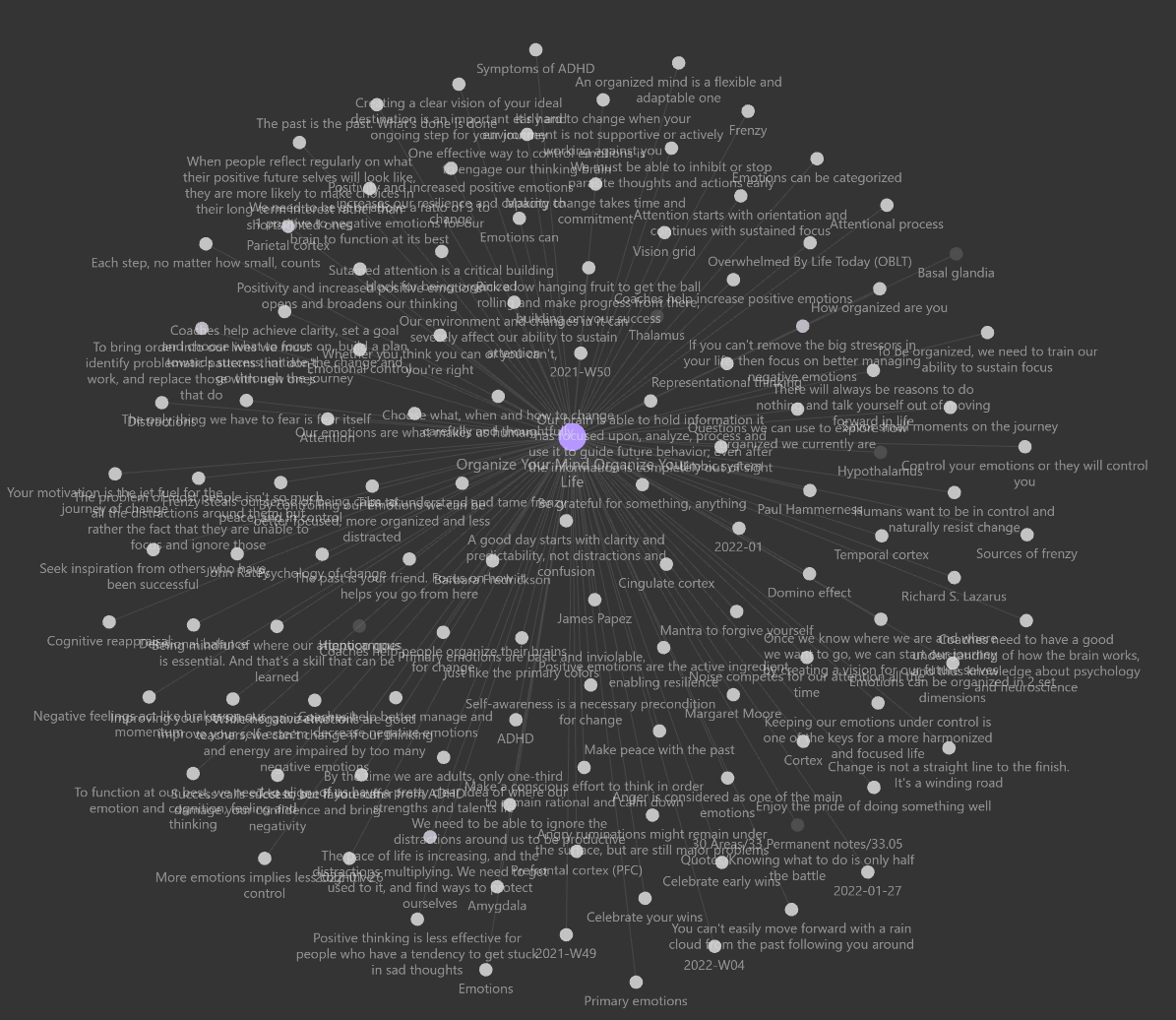
The atomic notes I have extracted from that book's "summary"

As you can see, I've turned one long note into a useful graph of knowledge. And now, I get to connect all those separate pieces to other ideas I capture over time, further compounding the value of my personal knowledge base.

Going further

The example I've included in this article has been created using Obsidian and my Obsidian Starter Kit. The Obsidian Starter Kit serves as the perfect launching pad for your PKM journey, providing you with the organization system, tools, templates, and best practices to start managing your knowledge efficiently and effectively. It's designed to help you understand the core principles of PKM, how to structure your notes, and how to create a network of linked thoughts.

Obsidian Starter Kit
Jump straight to stress-free note-making with Obsidian

Note that I have also created an accompanying video course that covers everything from the basics of Obsidian to advanced Personal Knowledge Management practices:

Obsidian Starter Course
Who is this for?You are just getting started with note-taking or you’ve recently switched to ObsidianYou want to discover Obsidian and its key featuresYou wonder how to take smart notesYou want to know how to properly organize your notes and avoid creating an overwhelming messYou want a solid system that scalesYou wonder what Zettelkasten, the PARA method, and the Johnny decimal system areYou have bought the Obsidian Starter Kit and want a full video course to help you get startedGetting started with Obsidian is not the hardest thing in the world, but it takes a lot of trial and error to figure out how to structure and organize your knowledge base. You have a busy life, and you don’t want to spend weeks or even months figuring out the “right” approach.What is this?The Obsidian Starter Course is a video course containing 2h20 of content. It’s a hands-on guide into the world of Obsidian, Personal Knowledge Management (PKM), and the Obsidian Starter Kit.Many of the explanations use the Obsidian Starter Kit’s vault/structure/plugins, but the explanations about Personal Knowledge Management (PKM), Markdown, YAML and recommendations can be applied to many other tools. Moreover, if you’re using Obsidian but don’t yet have a copy of the Obsidian Starter Kit, then this course is still incredibly useful. It will show you how you can organize your knowledge base, how to take smart notes, and much more!What’s in the video course?The Obsidian Starter Course covers the following topics:Obsidian: installation, user interface, key features, plugins, automation, tips and tricks, etcThe Markdown syntaxYAML metadataPersonal Knowledge Management techniques and principles: the Johnny Decimal system, the PARA method (e.g., the Zettelkasten method, the LIFT principle, Atomic notes, Maps of Content, knowledge capture & extraction, etc)JournalingPeriodic reviewsTemplatesAutomationTask managementBest practices and recommendationsHands-on explanationsand more!Refunds policyIf you’re not 100% satisfied, then just let me know, and I’ll issue a full refund. I’ll only ask you a single question: How can I improve the product?If you think about asking for a refund, then consider reaching out to me with your issues, questions, and remarks. I’m always available and happy to help. My goal is to help you succeed.

For those of you looking to delve deeper into the realms of note-taking, PKM, personal organization, productivity, and knowledge work in general, the Knowledge Worker Kit acts as an advanced companion, offering insights, strategies, mental models, templates, guidance, and a private community to help you become future-proof knowledge workers and lifelong learners.

Knowledge Worker Kit and community (BETA)
Who is this for?You are a Knowledge Worker or Lifelong LearnerYou feel disorganized, unproductive, or overwhelmedYou don’t know how to go to the next levelYou want to learn from someone who’s always on top of thingsI have a proven track record of delivering at work and with my side projects. I have worked as a software developer, team leader, project manager, IT architect, information management specialist, CTO, founder, coach, and solopreneur. I have also written and published 3 books, 300+ articles, courses, YouTube videos, digital products, manage communities, and more! And I did it all with a busy life and kids. My personal system works and helps me achieve my goals consistently.You want a solid system that scalesBeing a Knowledge Worker today is much more challenging than it ever was. Getting started ain’t easy, and there are many traps to fall into. Spare yourself some time and benefit from my experience and battle-tested system. I’ll share everything I know with you: my approach, my systems, my routines, templates, guidance, and more! My mission is to help you avoid the pitfalls of Knowledge Work and empower you through technology.After you finish exploring the guide, you’ll have:Clarity in your life and an obvious path forwardSolid habits, routines, and systemsClear ideas about how to “manage” your careerAn effective approach to learning new thingsSolid knowledge management and personal organization systemsKnowledge about how to organize, plan, control, and manage projects (large and small!)A toolkit to prioritize workA system to manage your tasks at scaleEffective means to focus your attention and manage your timeWork methods that will propel your career forwardWhat is this?I’ve been passionate about information, knowledge management, learning, personal organization, PKM, and productivity for more than 20 years. As an author, blogger, knowledge worker, entrepreneur, coach, and father of 3 kids, I needed effective solutions to be and stay organized, focused, and productive. The Knowledge Worker Kit includes everything I know about these topics, and more!What’s included?WARNING: The Knowledge Worker Kit is in BETA. The content will be added and expanded over time. If you buy access now, you’ll benefit from a lower price. The product is already available so that I can find early adopters and get as much feedback as possible in order to make it great for everyone.If you buy access to the Knowledge Worker Kit, you’ll get:The user guideAll the templates and guidanceLifetime access to the private community for support and knowledge sharingLifetime access to all community events (meetups, workshops, knowledge-sharing sessions, invited talks, etc)Ask Me Anything (AMA) Q&As with meIn addition, you’ll also get free access to all future updates. Over time, I’ll continue expanding the kit with new ideas, techniques, systems, templates, and more!What’s in the user guide?The user guide is a growing and evergreen knowledge base. It includes detailed explanations covering a wide range of topics that all Knowledge workers should explore:01. Clarity: values, behaviors, goals, non-goals, priorities, and intentions02. Habits, routines, systems, processes and methods03. Career Management and Anticipation04. Learning05. Projects Knowledge Management and Journaling06. Projects Organization07. Planning and Prioritization08. Task Management09. Focus, Attention, Time Management and Action10. Personal Development11. Control: periodic reviews, progress tracking, course-adjustment12. Personal Organization13. WorkThe user guide is a Notion space including tons of articles, how-to guides, guidance, and links to useful templates and resources.You will get to explore the content at your own pace, and to focus on what is useful to you right now, as each section is actionable on its own.Evergreen ContentThe Knowledge Worker Toolkit is going to expand over time. Day after day, week after week. Buy it once, and you will have access to all future updates.Overview of the main topics01. ClarityThis part explores key elements that help bring clarity to one’s life:NeedsValuesPrinciplesGoalsPrioritiesEach of those is important to know what matters, what has value, and what to focus on.02. Habits, routines, systems, processes and methodsThis part explores the base elements of productivity systems:Habits and routinesSystems, processes, and methodsThose are key to building an “effortless” life, requiring as little willpower/motivation as possible to make things happen.03. Career Management and AnticipationThis part focuses on career management: its importance, your responsibility, the mindset you need to acquire, and all the related ideas.04. LearningThis part shares ideas about how to…Learn how you best learnLearn more effectivelyExplore new topicsResearchFilter informationLeverage AI and LLMs…05. Personal Knowledge Management (PKM) and JournalingThis part explores how to collect, organize, and link all your knowledge and information. It explores the main concepts of PKM, note-taking, note-making, tools of the trade, and structures/tips to help you keep everything useful, manageable, and maintainable as your knowledge base grows.It also introduces journaling and how to approach it to support your whole life.06. Projects OrganizationThis part focuses on how to organize projects and their information in a way that enables you and your teams to make focused progress.It shares ideas about how to organize project information, how to document projects, how to organize backlogs, etc.07. Planning and PrioritizationThis part focuses on how to plan projects and tasks, how to deal with deadlines, and how to prioritize work using various methods.08. Task ManagementThis part focuses on task management for personal and professional projects. It explores ways to keep tasks under control, how to organize personal work, and how to make the link between your different backlogs and your day-to-day life.09. Focus, Attention, Time Management and ActionThis part focuses on how to make things happen every single day, regardless of whatever is going on in your life. It’s all about techniques, tips & tricks, and tools to help you better manage your time, focus, and attention in order to ACT.10. Personal DevelopmentThis part explores important aspects of Personal Development that can make a big difference in a Knowledge Worker’s life. A sane mind in a sane body.11. ControlThis part is dedicated to control. How to control your progress, your trajectory, your projects, etc. And also, how to adjust course when things don’t go as expected.12. Personal OrganizationThis part helps better organize yourself and your information. It shares “zen” techniques you can use to remain organized, independently of how much information you have to juggle with.13. WorkThis part is all about WORK. How to do the work, how to improve your attitude, your results, and your recognition. It also dives into how to better collaborate with others to achieve your goals and those of your company/group.

Investing time and effort into PKM, and utilizing resources like the Obsidian Starter Kit and the Knowledge Worker Kit, is an investment in yourself. It's about becoming more efficient, effective, and fulfilled in your personal and professional life. By embracing these tools, you're not just managing knowledge; you're setting the stage for continuous growth, innovation, and success.

Conclusion

The transition from long-form note-taking to creating and connecting atomic notes can significantly impact your efficiency and effectiveness in handling information. By breaking down complex or extensive notes into smaller, interconnected pieces, you not only improve the accessibility of your knowledge but also enhance your ability to think critically and make connections between ideas. Embracing the atomic notes approach is a step toward much more dynamic and flexible knowledge management, where insights are not buried under the weight of words but are instead readily available at your fingertips.

Ready to get to the next level?

If so, then check out the Knowledge Worker Kit, the Obsidian Starter Kit, the Obsidian Starter Course, the PKM Library, a PKM coaching session with me, my collection of books about software development and the IT Concepts Wall 🔥.

If you want to discuss, then don't hesitate to join the Personal Knowledge Management community or the Software Crafters community.

About Sébastien

Hello everyone! I'm Sébastien Dubois (you can follow me on Twitter 🐦).

I'm an author, founder, and CTO. I write books and articles about software development & IT, personal knowledge management, personal organization, and productivity. I also craft lovely digital products 🚀

If you've enjoyed this article and want to read more like this, then become a member.