
How One System Feeds Everything I Do: From Scattered Chaos to Unified Creation

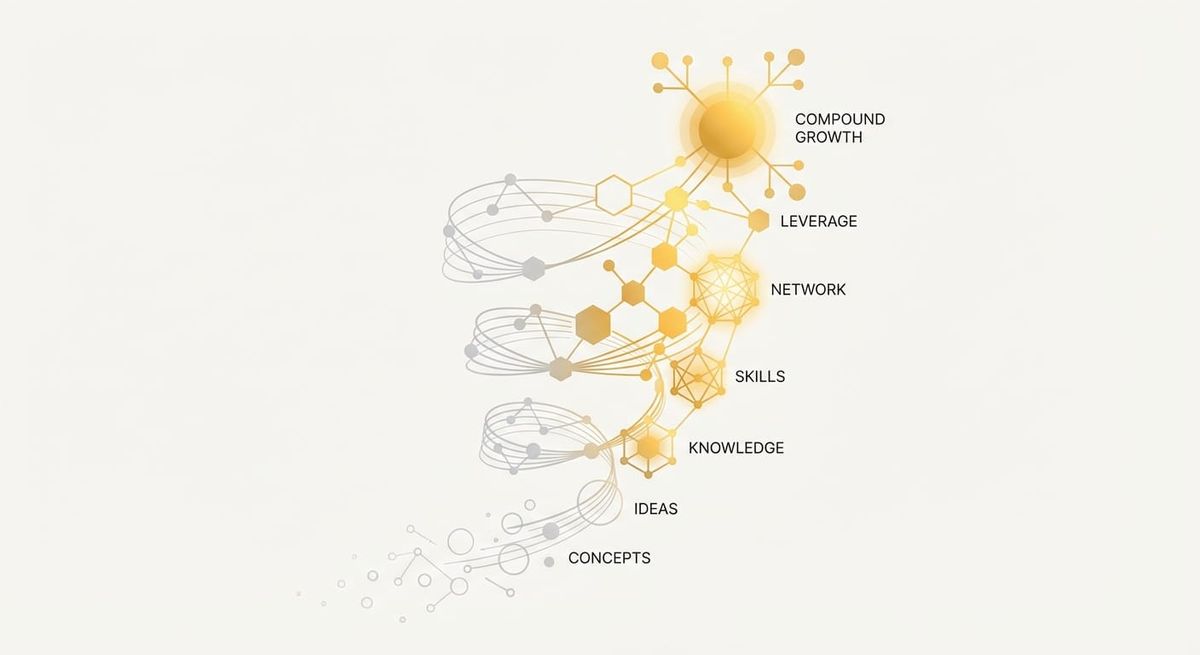
You're bleeding time and money every single day. And you probably don't even realize it.
Every time you recreate work you've already done. Every time you can't find that brilliant idea you captured somewhere. Every time you start a project from scratch instead of building on what you already know. Every time you make a decision without the full context.
The result: Inconsistent output. Missed opportunities. Creative burnout. Revenue left on the table. It doesn't have to be this way.
In this article, I want to show you how one unified system supports my ability to create content, build products, make decisions, and run my business. And more importantly, why consolidation (not complexity!) is the key to sustainable creation.
Introduction
I used to be drowning in information chaos. No kidding!
Ideas scattered across dozens of apps. Notes trapped in closed systems. Knowledge recreated from scratch every single time. One tool for writing, another for planning, a third for learning, a fourth for business decisions, yet another for todo lists, ... Each project started with a blank slate because I had no way to leverage what I'd already built.
The result? Inconsistent output. Forgotten ideas, feast-famine cycles and constant context switching. The exhausting feeling that I was working incredibly hard but building nothing that lasted.
But the problem wasn't lack of inspiration or discipline. The problem was my system. Or rather, my complete lack of a solid one.
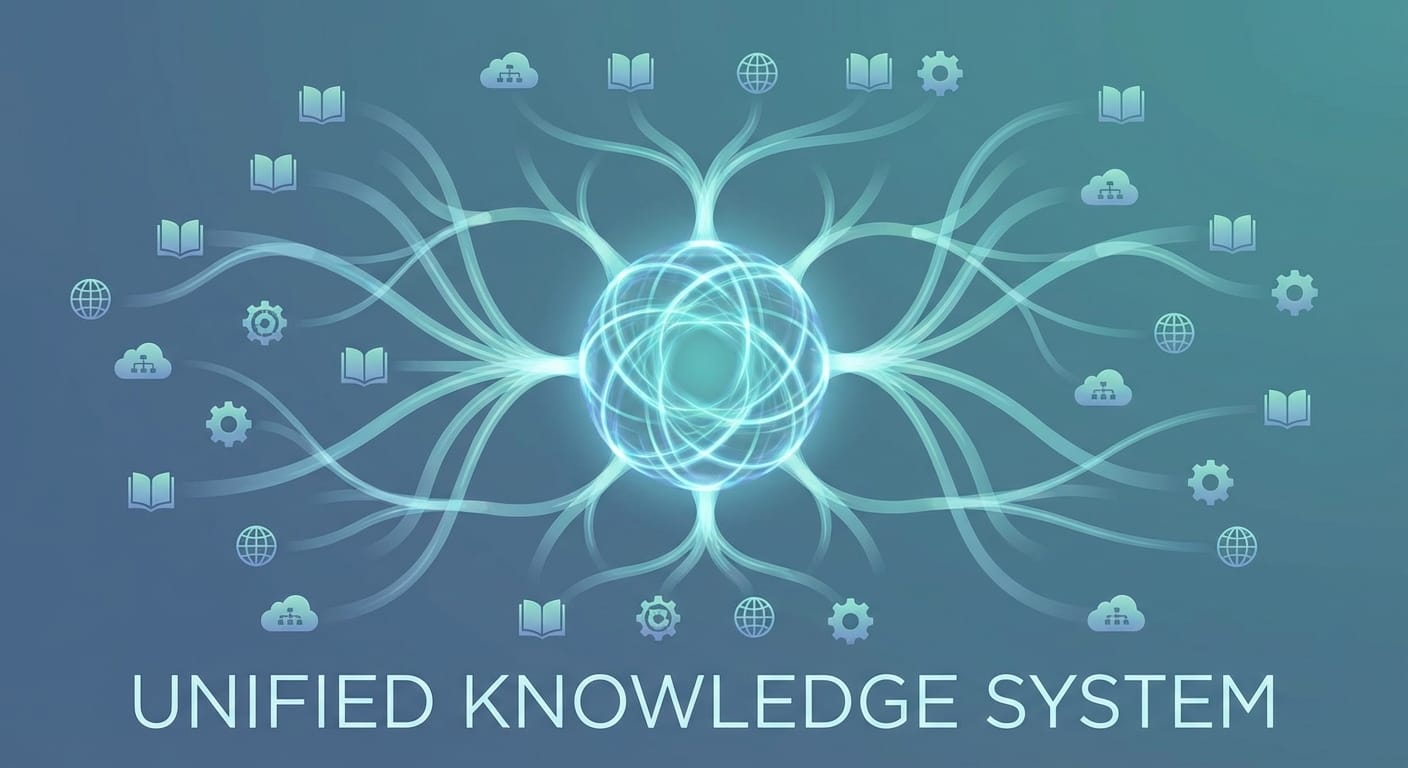
Today, everything I do flows through a single unified system. My Personal Knowledge Management System (PKMS) forms the core of what I call my "BuilderOS". It's the operating system for my entire creative and professional life.
This one system feeds:
- Content creation (articles, newsletters, videos, social posts)
- Product development (courses, tools, templates, communities, etc)
- Business operations and strategic decisions
- Learning and personal growth
- Action management (goals, plans, projects, tasks)
- Deep thinking, journaling, and periodic reviews
And you know what? It works not despite its simplicity, but because of it.
TL;DR
The shift from scattered tools to one unified system:
- One central place eliminates the chaos of information scattered across multiple apps
- Knowledge captured once gets reused infinitely across different outputs
- Connections between ideas create exponential value over time
- Integration with action transforms notes from archives into operating systems
- The system makes you organized (you don't need to be "naturally organized" first)
- Starting small and evolving beats trying to build the perfect system upfront
- The cost of NOT having a system far exceeds the investment of building one
- Success comes from consolidation and connection, not capture and complexity
- It's designed for messy reality, not perfect inputs
- This approach enables faster content creation, more consistent output, and better business decisions
This is a topic I've touched on many times before; you need fewer tools, not more:

Before: Drowning in Digital Chaos
Let me paint you a picture of what my creative life looked like before I built this system.

I had notes in Evernote, ideas in a wiki, tasks in Trello, drafts and documents in Google Docs, bookmarks in my browser and in other tools, highlights in my books or stuck on my e-reader, thoughts in random text files, and sticky notes on my desk. Each tool was supposed to solve a specific problem. Instead, they created a bigger one: fragmentation; Information silos.
When I sat down to write an article, I couldn't find half the research I'd done. When I planned a new product, I was starting from scratch instead of building on past learnings. When I made business decisions, I lacked the context I needed because it was scattered across a dozen different places.
The hidden cost was massive:
Every project required recreating knowledge I'd already captured somewhere. Every article started with a blank page instead of a foundation of connected ideas. Every decision was made with incomplete information. I was constantly forgetting valuable ideas because there was no system to surface them when I needed them.
Beyond that, there was the mental overhead. The constant question of "where did I save that?" The anxiety of knowing I was losing good ideas. The frustration of recreating work I'd already done. The feast-famine cycle of creation: prolific when inspired, silent when the muse didn't show up.
Your brain is for having ideas, not holding them
I was working incredibly hard but building nothing that compounded.
From Tools to System
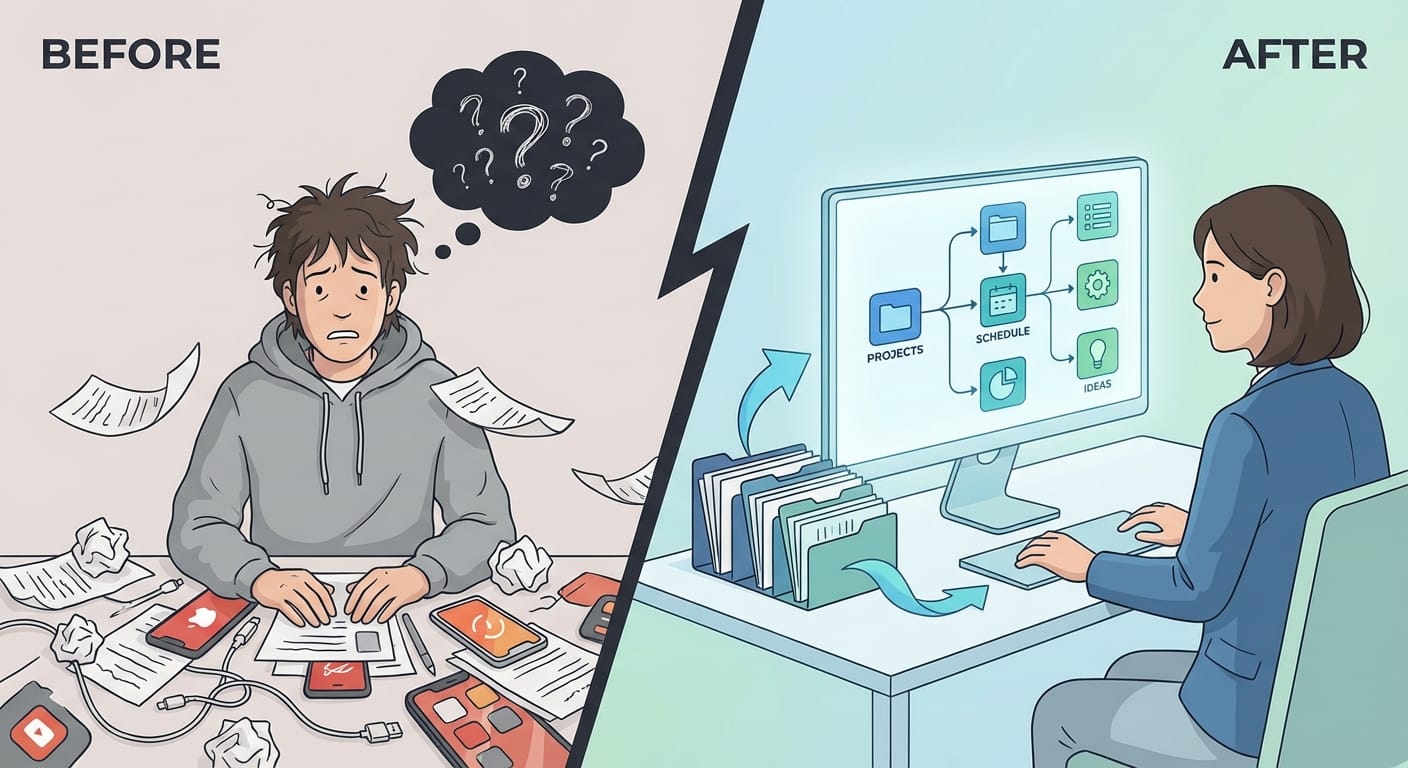
The shift didn't happen overnight. It happened through a series of "Aha" moments:
#1: It's not about the tools, it's about the system.
I'd been tool-hopping for years, always looking for the perfect app that would somehow organize my life. But no tool creates organization by itself. What creates organization is a system: clear workflows, intentional structure, and deliberate connections; information architecture and design.
#2: Consolidation creates value.
Having information in one place isn't just convenient. It changes the game you're playing. When everything lives in the same homogeneous system, you can connect ideas from different domains. You can find related information instantly. You can leverage past work instead of recreating it. The whole becomes greater than the sum of its parts.
Externalize, and centralize your knowledge. That's where it all begins
#3: Connections create value, not just capture.
Most people over-capture and under-connect. They save everything but link nothing. The real power isn't in the volume of notes you have. It's in how those notes connect to each other. And, critically, how they connect to your goals, projects, and daily work.
Connections between ideas are as valuable as the ideas themselves. Perhaps even more so
#4: Your Knowledge system should be an operating system, not an archive.
Over time, I stopped thinking of my notes as a library to consult occasionally. I started treating my knowledge system as the operating system for my entire creative and professional life. The central hub where all inputs flow in, get processed, and feed all outputs.
The right way to think about a PKM system is as an integral part of everything you do
Here's what it looks like in practice:
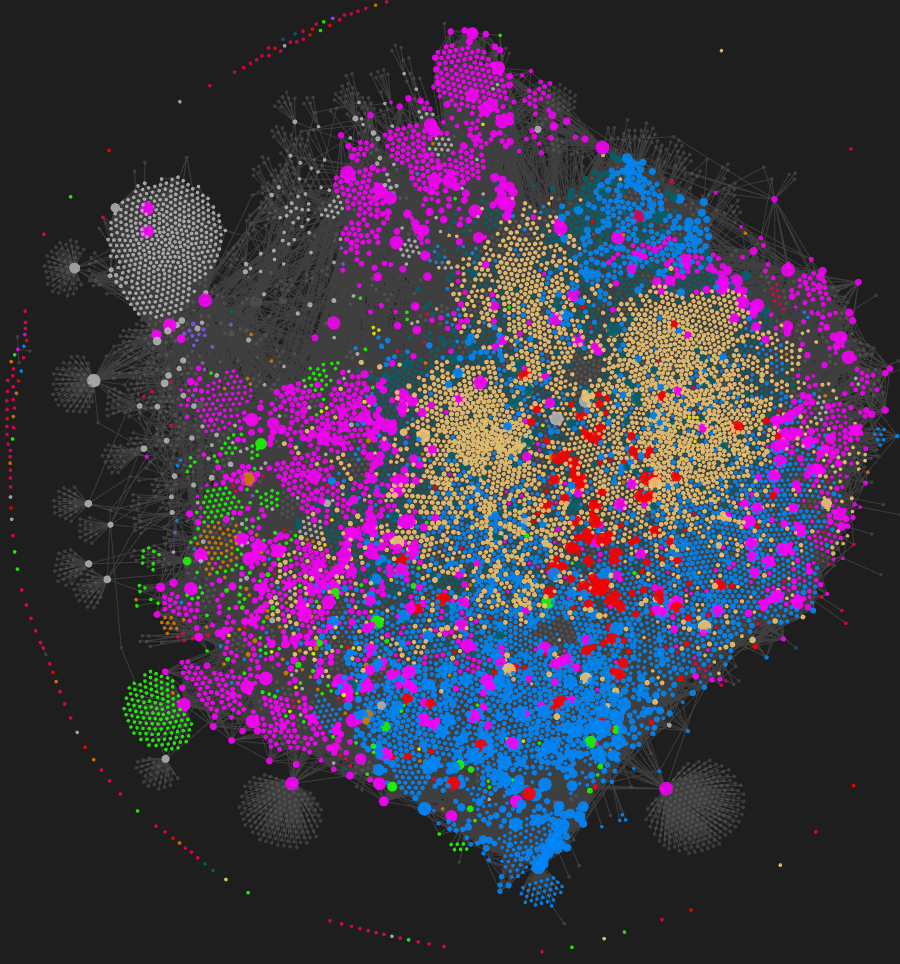
What Makes One System Actually Work
This isn't about having a note-taking app and using it from time to time. It's about building a system that turns knowledge into leverage.
Here's what makes a unified system actually work:
Everything in One Place
Not "most things" or "important things." Everything.
Your ideas, your learning, your goals, your projects, your tasks, your journal entries, your wins, your failures, your plans, your reviews, your analytics, your customer feedback. All of it, in one searchable, linkable, connected system.
Why does this matter so much? Because value emerges from unexpected connections. When you're reviewing your yearly results and can instantly access your journal entries, your wins, your product launches, your customer feedback, and your previous plans all in one place, you discover things you'd never find if that information was scattered.
A recent example: I just completed my yearly review. I opened my system and could directly find all the information I needed. My journal entries. My wins and failures. My achievements. The things I created. My previous plans. I reviewed it all and got a comprehensive picture of the year. Then I captured my sales data and analytics into the same system. This all became the input for elaborating my plans for the coming year.
This was only possible because everything lived in one place.
Designed for Reuse, Not Just Storage
Most people capture information but never design for future leverage.
In my system, when I capture something, I'm not thinking about how/where to store it, but about how I'll make use of it.
A customer question becomes a note that feeds an article, a social post, a course module, product documentation, etc. An article I write gets created from all the bits and pieces (i.e., Atomic notes). And it can all be recombined in different ways. A learning from a book connects to my existing knowledge graph and surfaces when relevant to new projects.
First and foremost, understand that capture without connection is just hoarding.
The difference between an archive and a system is intentionality. An archive stores. A system transforms.
Workflows That Connect Input to Output
Information flows through my system in clear stages. Here's how I think about the Personal Knowledge Management Process:
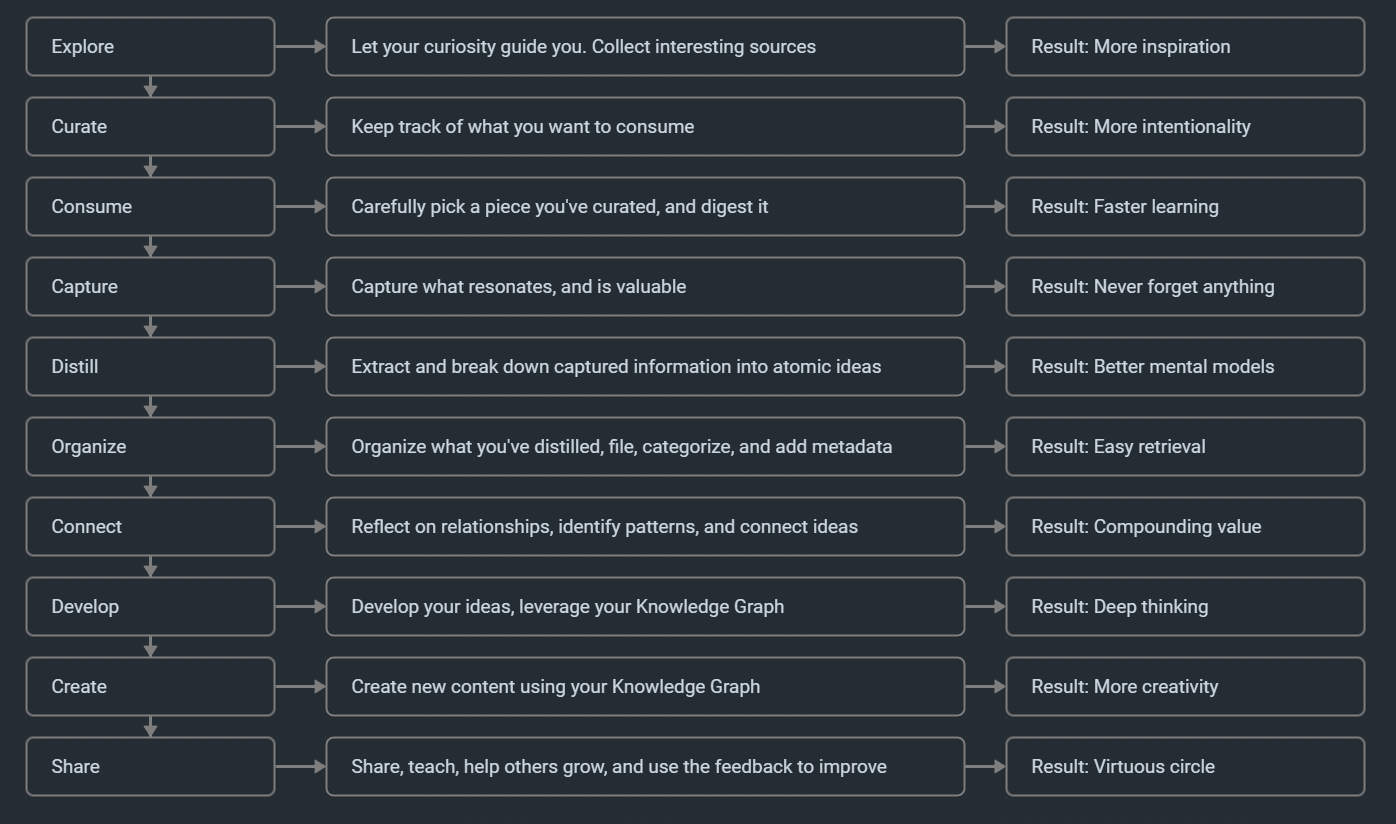
Explore → Let curiosity guide me, collect interesting sources
Curate → Keep track of what I want to consume
Consume → Carefully pick and digest curated pieces
Capture → Capture what resonates and is valuable
Distill → Extract and break down into atomic ideas
Organize → File, categorize, add metadata
Connect → Reflect on relationships, identify patterns, link ideas
Develop → Develop ideas, leverage the knowledge graph
Create → Create new content using the knowledge graph
Share → Share, teach, help others grow, use feedback to improve
Each stage has a purpose. Each stage adds value. And critically, each stage is designed to feed the next one.
This isn't a one-time process. It's a continuous cycle; a Virtuous circle. Sharing leads to feedback, which gets captured, which leads to new connections, which creates new content to share.
Integration With Action
This is what transforms a note-taking system into an operating system.
Your knowledge doesn't just sit there looking pretty. It connects directly to your goals, plans, projects, and daily tasks. When I'm working on a project, I can see all related notes, past attempts, relevant resources, and connected ideas. When I'm planning my quarter, I can pull from my learning, my reflections, my past wins and failures.
Notes without action are just pretty thoughts. Notes connected to action become leverage
My system doesn't separate "thinking" from "doing." My goals reference the knowledge that informs them. My projects pull from my Knowledge Graph (KG). My tasks link to the context I need to complete them effectively.
Built for (Controlled) Chaos, Not Perfection
My system works not because my inputs are perfect, but because it's designed to handle messy reality.
I don't spend hours perfectly formatting notes or agonizing over the ideal structure. I capture quickly, connect deliberately, and let the system evolve organically.
The power isn't in having a pristine vault. The power is in having a system that makes messy inputs valuable through connection and context.
I've built a solid core that continues to evolve based on my needs, and I rely on it all the time.
Knowledge Management vs BuilderOS: Understanding the Relationship
You might be wondering: what's the difference between Knowledge Management and BuilderOS?
Here's how I think about it:
PKM (Personal Knowledge Management) is the foundation. It's the core system for capturing, organizing, connecting, and leveraging knowledge. It's universal. Whether you're a creator, leader, student, or knowledge worker, PKM principles apply and are highly valuable.
BuilderOS is the complete creator operating system built on that PKM foundation. It takes personal knowledge management and extends it into a full system for creators building businesses through content and knowledge sharing.
Think of it this way:
- PKM handles your knowledge, learning, thinking, and ideas
- BuilderOS adds content pipelines, product development workflows, business operations, revenue tracking, audience management, and publishing systems on top of that knowledge foundation
PKM is a key component of BuilderOS, not a separate thing. It's the engine that powers everything else.
For creators, you need both. You need a solid knowledge management system to capture ideas, research, and learnings. And you need creator-specific systems to transform that knowledge into published content, products, and revenue.
That's what makes BuilderOS different from generic knowledge management. It's specifically designed for creators, with workflows that go from knowledge capture all the way through to content publication and business growth.
But it all starts with PKM. Without a solid knowledge management foundation, the rest falls apart.
If you're just starting, focus on building your PKM system first. Get good at capturing, organizing, and connecting knowledge. Then layer on the creator-specific workflows as you grow.
The Impact
Having such a system has enabled the following for me:
Faster content creation. I can write an article in a fraction of the time because I'm not starting from scratch. I'm pulling from existing notes, connecting ideas I've already developed, and building on foundations I've already laid.
More consistent output. Publishing regularly is not an issue anymore. Not because I'm more disciplined, but because I have a system that makes creation sustainable. No more feast-famine cycles. No more staring at blank pages. The system feeds my creativity.
Better business decisions. When I need to make a strategic choice, I have all the context in one place. Past decisions and their outcomes. My own reflections and learnings. I make better decisions because I have better information at my fingertips, and not scattered and hard to reach.
Cross-pollination of ideas. This might be the most valuable impact. Reading and writing about personal development, learning, and other topics led me to connect ideas from different fields. I could link those to my past experiences as an employee in a large organization. This cross-pollination allowed me to create content that builds bridges between different domains. Content that's unique because of those unexpected connections.
Compound value over time. Every note I write makes the whole system more valuable. Every connection I make creates new possibilities. Every piece of content I create feeds back into the system and can be leveraged again. The value compounds exponentially.
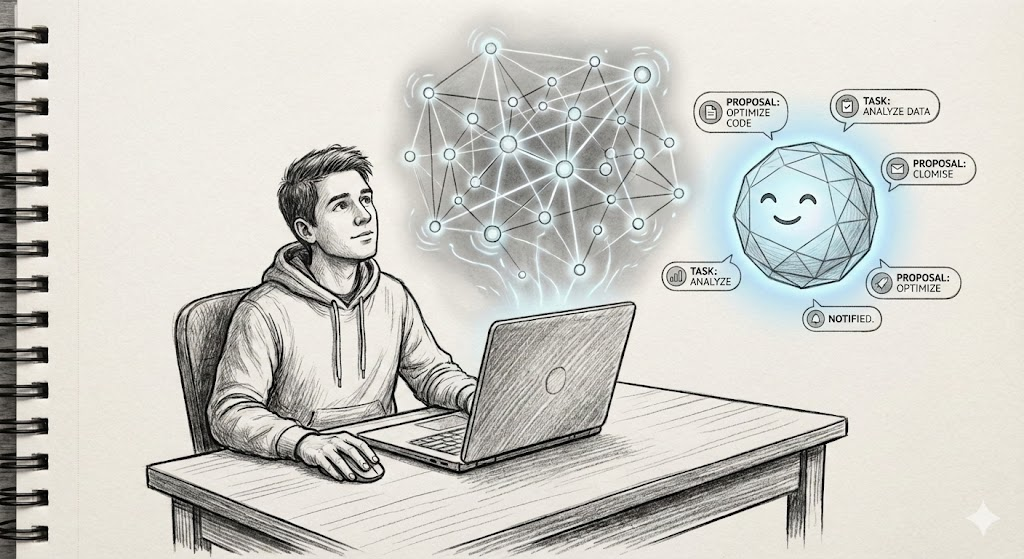
AI becomes a true amplifier. AI alone is powerful. But AI plus a unified system? Completely different game. When AI can tap into your structured knowledge — your context, your priorities, your goals, your projects, your business — it stops being a generic tool and becomes YOUR tool. It gets you. It understands where you're coming from and where you're going. The alignment improves. The results get sharper. The leverage multiplies. Your system isn't just good for you. It's what makes AI actually work for you.
Knowledge compounds over time. But only if you have a system
And it's a pattern that I've observed many times with highly successful creators. When you dig a bit, you quickly notice that they rely on a PKM system and leverage it to create and share their ideas at scale.
How This Actually Works
Let me show you what using this system looks like in practice.
Morning: I open my knowledge base and create (or open) my daily note. I can immediately see where I left things off yesterday, what I should focus on today. Everything is right there. No hunting across apps, no wondering where I saved that important link, no lost context.
There's no doubt, no lost links, no lost documents. Just pure focus with everything I need at my fingertips.
I can find everything back and get to work in an instant. My tasks for the day are linked to the projects they belong to. Those projects are connected to my goals. My goals reference the knowledge that informs them. It's all interconnected. And the result is full clarity over the what and the why.
Throughout the day: I go back to my daily note regularly. I capture information about what I'm doing. I update my task list. I keep track of what I've accomplished, challenges I've faced, things I'm grateful for, things I've discovered, etc.
And it's all tightly integrated into my work, not something that makes me lose focus. It's the power of knowledge management combined with interstitial journaling.
When I decide to create: If I want to write a new article or newsletter, I can quickly resurface ideas. I can see pieces I've already started that are in my content creation pipeline, the things I've learned or did recently, etc. I know what still needs to be published, its current state, its connections to other work.
It's all in one place.
Good systems prevent chaos. Great systems turn chaos into opportunities
And there's more: With a true BuilderOS approach, I can go even further and publish right from where I create, to different target platforms. The system doesn't just help me think and create. It helps me ship.
I capture throughout the day, use my daily note as a scratchpad and a place to think. At the end of the day, everything is there, safe and sound, and I can really disconnect from work; confident that tomorrow, when I sit down, all of this context will be waiting for me.
This is my Fourth Place. My place to think, create, and build. And it all happens in one system.
But Won't This Take Too Much Time?
This is the objection I hear most often: "This sounds great, but I don't have time to build and maintain a system like this."
You're already spending that time. You're just spending it inefficiently.
Think about it:
- How much time do you waste searching for information you know you saved somewhere?
- How often do you recreate work because you can't find the original?
- How many hours do you lose context-switching between different tools?
- What's the cost of making decisions without full information?
- How much creative energy do you burn dealing with the anxiety of scattered chaos?
You're already paying the price. You're just paying it in tiny, invisible increments that add up to massive waste.
The time investment to build yourself a solid system is real, but the value will compound. Yes, it takes time to set up your system. Yes, it takes intention to capture and connect information deliberately. Yes, there's a learning curve.
But that investment will be a net positive. The system will pay dividends. You'll create faster. You'll make better decisions. Your ideas will emerge from connections you didn't make at first. Every note you add will make your whole system more valuable. Every connection will create new possibilities.
Keep in mind that you don't build the whole system on day one. You start simple. One workflow at a time. One area at a time. It evolves with you.
And you're not alone in this. I've spent years making the mistakes so you don't have to. If you want to skip the trial and error and get started with a proven foundation, check out the Obsidian Starter Kit. It's the exact system I use, ready for you to make your own. No blank slate. No guessing where to start. Just a solid foundation you can build on from day one.
The real question isn't "Do I have time for this?" The real question is "Can I afford NOT to do this?"
What You Need To Do
If you're ready to build your own unified system, here are the mindset shifts that make the difference:
Think in systems, not tools. The app doesn't matter nearly as much as you think. What matters is your workflow, your structure, your connections. You could build this in Obsidian, Notion, Logseq, or even a folder of text files. Focus on the system, not the tool. And whatever you do, stop tweaking your tools endlessly and actually use them.
Design for reuse from day one. When you capture something, ask: "How might I use this in the future? What should this connect to?" This one question transforms storage into leverage.
Connect knowledge to action. Your system should inform what you do, not just what you know. Link your notes to your goals. Connect your learning to your projects. Make knowledge actionable.
Build an operating system, not an archive. This is the most important point of it all. Stop thinking of your knowledge system as a place to store things you might need someday. Start thinking of it as the central nervous system of your creative and professional life. The place where everything flows in, gets processed, and feeds everything you do.
Embrace evolution over perfection. You don't build the perfect system on day one. You start simple, use it consistently, and let it evolve based on your actual needs. The system grows with you.
Common Mistakes to Avoid
Avoid tool proliferation.
More tools doesn't mean more capability. It means more fragmentation, more context switching, more places to forget things, more complexity, more costs, more integration issues, etc. Using fewer tools is a feature, not a limitation.
Other mistakes I see constantly:
- Capturing everything but connecting nothing
- Building elaborate structures before having content to organize
- Optimizing for storage instead of retrieval and reuse
- Treating the system as separate from daily work instead of integral to it
- Waiting for the perfect system instead of starting simple and iterating
These mistakes come from misunderstanding what makes a system valuable. It's not complexity. It's not completeness. It's consolidation and connection.
Quick Wins
You don't have to build the complete system to start seeing value. Here are a few quick wins:
1. Peace of Mind
The moment you consolidate into one system, you stop wondering "where did I save that?". You always know where to start: your system. This alone is powerful.
The system becomes your Fourth place. Your dedicated space for thinking, creating, and building. The anxiety of scattered information starts to fade.
When you capture, you don't have to wonder where things should go. Your system has a place for everything.
2. Faster Retrieval
As soon as everything is in one searchable place, you find things faster. No more checking five different apps. No more "I know I saved this somewhere." You search once, in one place, and it's there.
When you need to find something, you always know where to start: your system. One search. One place. Done.
3. Better Capture
When you have one clear system for capture, you stop losing ideas. You know exactly where to put that brilliant idea, that customer feedback, that random thought. It all has a home.
And because you're leaving breadcrumbs (links and connections), you're making it easier to find things back later. You're building value even as you capture.
4. Serendipity
As soon as you start linking notes, you get the opportunity to "stumble upon" unexpected relationships and connections. An old note surfaces at exactly the right time. An idea from one domain sparks a connection in another.
This serendipity creates real value. Ideas you wouldn't have had if everything stayed siloed.
5. Faster Creation
Once you have even a small collection of connected notes, content creation accelerates. You're not starting from a blank page anymore. You're pulling from existing ideas, building on past thinking, connecting concepts you've already developed.
Everything is at your fingertips, and it's all connected. But you can also wander and enjoy serendipity.
The compound effect: Each of these quick wins builds on the others. Peace of mind makes capture easier. Better capture improves retrieval. Connections create serendipity. Serendipity speeds up creation. And all of it reduces anxiety and increases creative confidence. It's a Virtuous circle.
You don't need the perfect system to start experiencing these benefits. You just need to start.
How to Start Building Your System
You don't need to rebuild everything overnight. Here's how to start:
1. Pick one tool and commit. Stop tool-hopping and stop tweaking. Choose one system (I use Obsidian, but find what works for you) and commit to building in it. Consolidation is the point.
If you want to understand the "why" behind knowledge management before diving into tools, my Knowledge Management for Beginners course covers everything from first principles to advanced workflows. It's the foundation that makes everything else click.
Externalize, and centralize your knowledge. That's where it all begins
2. Create core areas. Start simple; use the PARA method. Create spaces for...
- Inputs: Where new information lands (inbox, quick captures)
- Knowledge: Your connected notes and ideas (permanent notes, concepts, learnings)
- Action: Your goals, plans, projects, and tasks
- Output: Your created content, products, and work
- Reflection: Your journal, reviews, and synthesis
3. Build one workflow at a time. Don't try to systematize everything at once. Pick one workflow (e.g., "idea to article") and get that working reliably. Then add the next one.
4. Connect deliberately. When you create a note, immediately link it to related notes. When you capture an idea, connect it to a project or goal. When you learn something, link it to existing knowledge. Connection is what transforms notes into a system.
5. Use it daily. The system only works if you actually use it. Make it your starting point for projects, your capture tool for ideas, your planning system for goals. The more you use it, the more valuable it becomes.
In general, my recommendation is really to start with Journaling and Interstitial Journaling in particular. It's the simplest way to integrate your knowledge system in everything that you do.
The Real Cost of NOT Having a System
Every day without a system, you pay a hidden tax. Recreated work. Lost ideas. Decisions made with incomplete context. Opportunities missed because the right information didn't surface at the right time.
You're already spending the time. A unified system just redirects it into something that compounds.
A great artist with a bad system can be beaten by a mediocre artist with a good one
Going Further
Building a unified system that feeds everything you do isn't easy. But you don't have to figure it out alone.
I've spent years developing, refining, and teaching the foundations that underpin these systems. I'm here to help through:
- Knowledge Management for Beginners - My in-depth course that walks you through building your own knowledge system from scratch, with clear frameworks and step-by-step guidance
 Knowledge Forge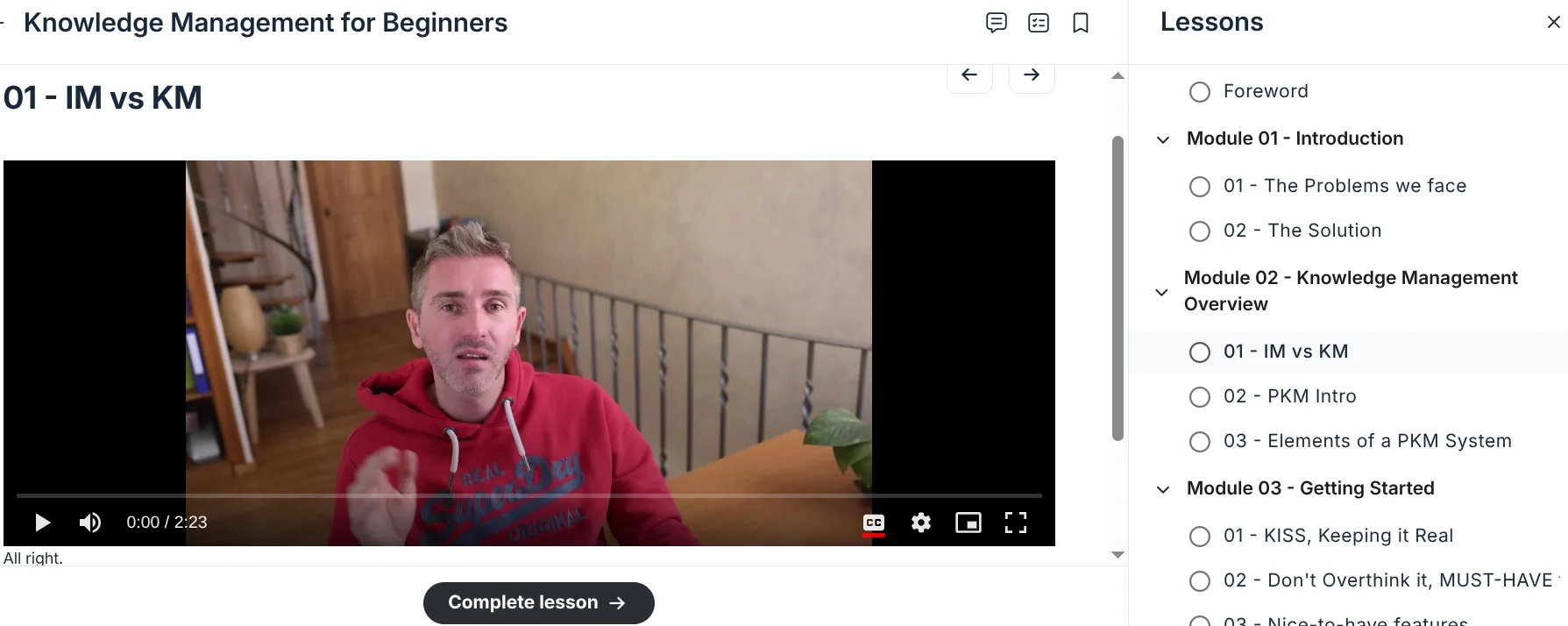
- The Obsidian Starter Kit - A complete template to jumpstart your system without starting from a blank slate
 Knowledge Forge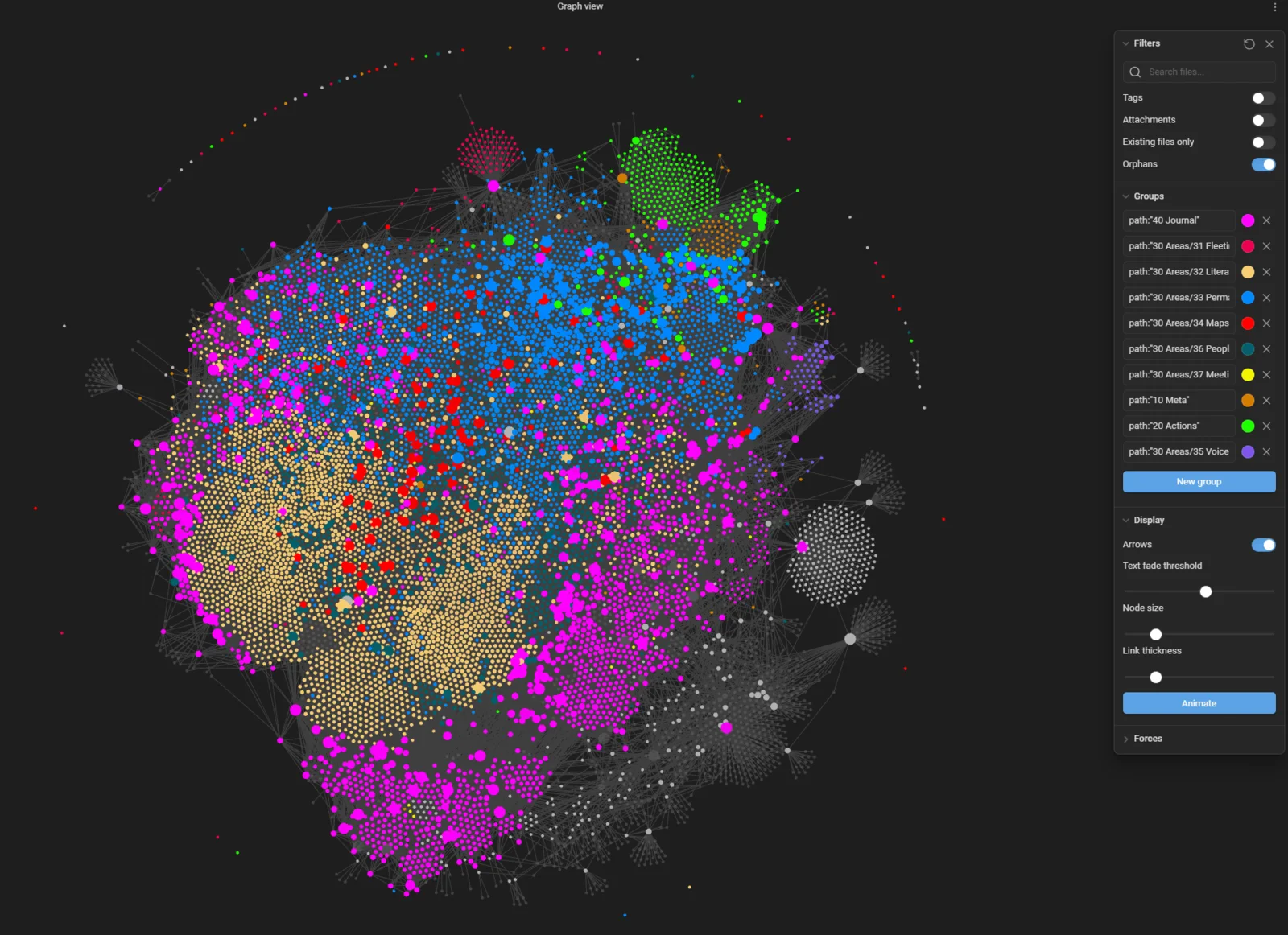
- BuilderOS - The complete creator operating system I'm currently documenting and sharing, combining knowledge management, content creation and business operations. I work on this as part of the Knowii Community
 Knowledge Forge
I'm also building these in public, sharing the process, the decisions, and the systems as they continue to evolve. You can follow along and implement the same approaches in your own work.
Conclusion
Going from scattered chaos to unified creation isn't about finding the perfect tool or building the most elaborate system.
It's about understanding that consolidation creates leverage.
When everything lives in one place, you can connect ideas across domains. When you design for reuse, every piece of work compounds. When you integrate knowledge with action, notes become operating systems instead of archives. When you build workflows that connect input to output, creation becomes systematic instead of sporadic.
This one system feeds everything I do. Every article I write, (almost) every social media post I create, every product I build, every decision I make, every plan I create. It all flows from and feeds back into this unified system.
The system makes me faster. More consistent. More creative. More effective. Not because it's complex, but because it's consolidated.
Your turn.
Stop letting your knowledge scatter. Stop recreating work you've already done. Stop making decisions with incomplete information. Stop treating your notes as an archive instead of an operating system.
Start building the one system that feeds everything you do.
That's it for today! ✨
Go Further
 Sébastien Dubois
 Sébastien Dubois
 Sébastien Dubois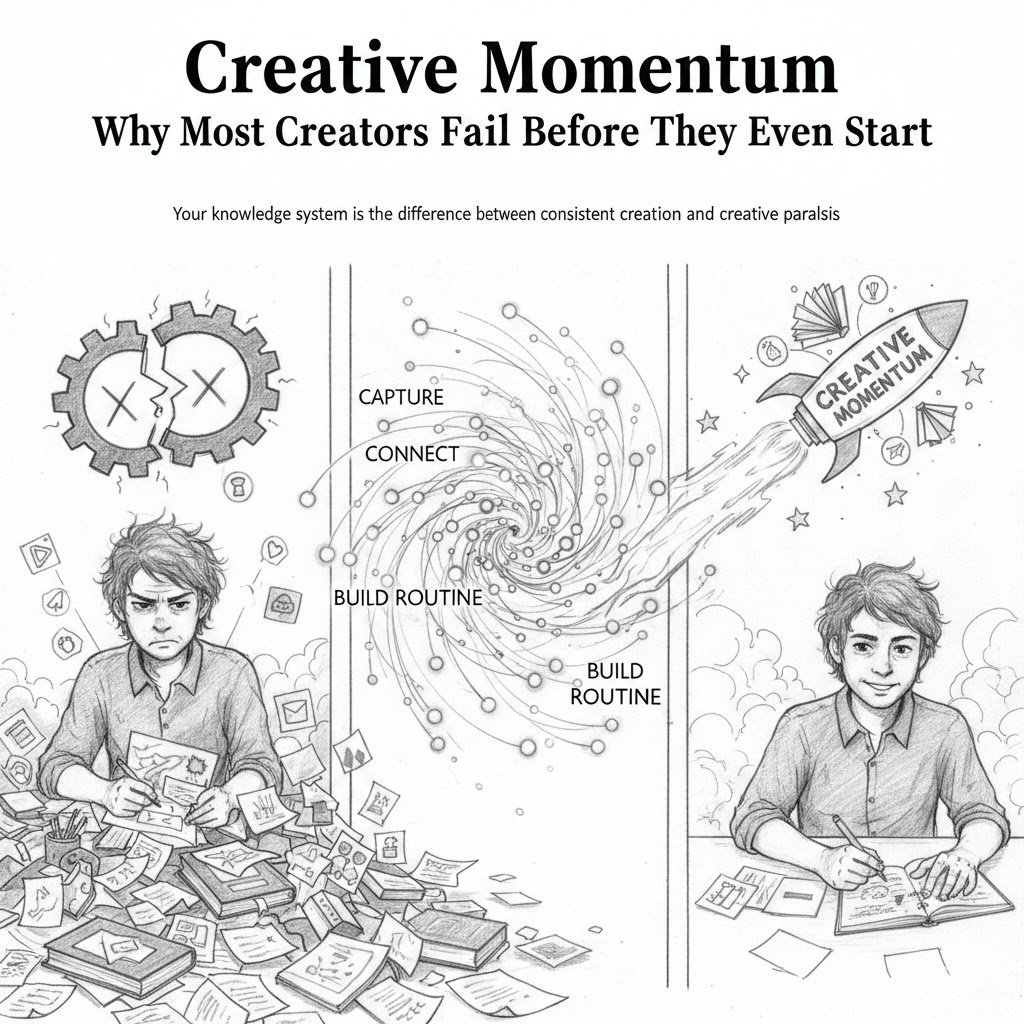
Want to go deeper?
Sébastien Dubois
About Sébastien
Ready to get to the next level?
Found this valuable? Share it with someone who needs it.