

DeveloPassion's Newsletter #216 - My AI Assistant Is Turning Into an Operating System
A newsletter discussing AI, Knowledge Work, Knowledge Management Systems, Zen Productivity, Personal Organization, and everything in between!
A newsletter discussing AI, Knowledge Work, Knowledge Management Systems, Zen Productivity, Personal Organization, and everything in between!
You Think Faster Than You Type Your Keyboard Is Costing You Hours Every Week
Aliases give a note alternative names. They are defined in the note's frontmatter (see Obsidian Properties) and picked up everywhere Obsidian resolves names: wikilink autocomplete, the Obsidian Quick Switcher, and unlinked mentions.
Embeds display the content of another file inside the current note. The syntax is a wikilink prefixed with `!`. This is Obsidian's implementation of Transclusion: content lives in one place and gets reused by reference, never copied.
Obsidian search (backed by the Search core plugin for Obsidian) is full-text search across the whole vault, with operators that most users never discover. Learning a handful of them is the difference between scrolling through results and getting exactly the notes you meant.
The way I use AI has gone through many iterations already. Writing them down in order makes the direction obvious, so here they are.
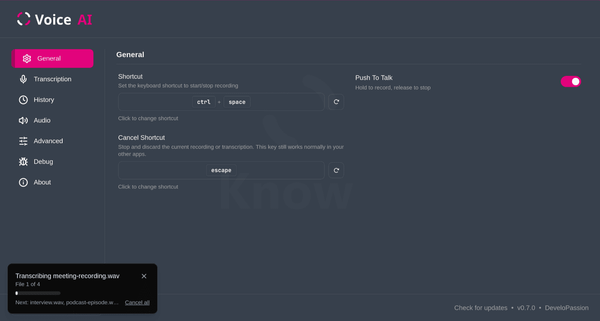
Knowii Voice AI 0.8.0 is out. Drop audio or video files onto the app and they come out as text, the transcribe CLI now ships in every installer, and transcriptions come out cleaner thanks to word replacements, phonetic fixes and filler word removal. Everything still runs entirely on your machine.
Model routing is the practice of directing different tasks to different AI models based on the task's requirements. Instead of using one model for everything, a routing layer selects the most appropriate model considering capability, cost, speed, and context needs.
Microsoft eXecution Container (MXC) is an open-source (MIT License) sandboxed code execution system from Microsoft for running untrusted code (model outputs, plugins, tools) safely on Windows, Linux, and macOS. Instead of shipping one isolation technology, it puts multiple containment backends, from
Zellij is a modern terminal multiplexer written in Rust. It positions itself as a "terminal workspace" that doesn't sacrifice simplicity for power; discoverable UI with on-screen keybinding hints makes it approachable without limiting what power users can do.
GHE.com is the version of GitHub Enterprise Cloud with data residency: a managed cloud GitHub where a company chooses the region its code and data are stored in. Each enterprise gets a dedicated subdomain (e.g. `octocorp.ghe.com`) with its own namespace, fully isolated from the open-source community
Awesome GitHub Copilot (awesome-copilot.github.com) is GitHub's official, community-driven catalog of resources that extend GitHub Copilot. Maintained by GitHub with community contributions, backed by the `github/awesome-copilot` repository. It's the de facto marketplace for Copilot customizations a
Canvases are durable, shared visual surfaces in the GitHub Copilot App where you and an AI agent operate on the same plan. Instead of workflow state living buried in chat history, a canvas makes it explicit and persistent: phases, decision points, validation gates, and drafts update live as the agen
GitHub Copilot MCP Registry is the ability, in public preview, to point a GitHub organization or enterprise at a private MCP) registry so that GitHub Copilot clients only discover, and optionally only allow, the MCP servers your company approves. Admins configure it under AI Controls → MCP in the or
GitHub Copilot Sandboxing is GitHub's answer to the "agent with full shell access" problem: two complementary isolation modes for running GitHub Copilot CLI agent sessions, both in public preview. Local sandboxing wraps the commands an agent runs on your machine in an OS-level sandbox powered by Mic
Programs that let you run multiple terminal sessions inside a single terminal window or remote connection. Key capabilities: split panes, multiple windows/tabs, session persistence (detach/reattach), and remote session survival (SSH disconnects don't kill your processes).
Callouts are styled block elements in Obsidian that highlight important information using a special blockquote syntax. They replace the older Admonition plugin for Obsidian approach with a native, built-in feature.
Obsidian URI is the custom `obsidian://` protocol that Obsidian registers with the operating system. It lets any external application (browser, launcher, task manager, script) open vaults, jump to notes, run searches, and create content. No plugin needed; this is the official way to control Obsidian
A new open specification landed: Agent Plugins 1.0, with an initial technical steering committee made of Amazon, Cursor, Microsoft, OpenAI and Vercel. It defines a portable package format for extending agents, so an extension is authored once instead of being repackaged per client.
Remotely Save, synchronizes an Obsidian vault with cloud storage you already have: Dropbox, OneDrive, Google Drive, any WebDAV server, or S3-compatible object storage (AWS S3, Cloudflare R2, MinIO, Backblaze B2, and similar). It is a lightweight alternative to Obsidian Sync for people who prefer to
OpenRouter extended its "one API for every model" promise to speech-to-text. A new endpoint (`POST /api/v1/audio/transcriptions`) accepts base64-encoded audio and returns the transcript as JSON, using the same API key as chat completions. No separate STT provider, no extra server.
While every model announcement brags about bigger context windows, OpenAI went the other way: the Codex model's context size dropped from 372k to 272k tokens. No announcement; the change surfaced as a pull request in the open-source Codex CLI repo, and promptly hit the Hacker News front page because
The Notebook Navigator plugin for Obsidian just hit a milestone: it's now the #1 most popular plugin in the Obsidian community directory, and should pass a million downloads within weeks. Not bad for a file explorer replacement.

Tools
Obsidian automation is three layers stacked on one idea: your notes are plain files, so anything can operate on them. Here is the complete map, from your first template to an AI Operating System.
A clear roadmap to building your own knowledge system. Subscribe and get it straight to your inbox.
6,000+ readers. No spam. Unsubscribe anytime.