
Journaling Is the Most Underrated Knowledge Management Habit


In this article, I want to explain (once again!) why Journaling is one of the most powerful knowledge management habits you can build, and why your daily note deserves a central place in your Personal Knowledge Management (PKM) practice.
Introduction
When you hear "journaling", you probably think about telling your stories, explaining your feelings, and trying to understand yourself.
Yes, that's part of journaling. But there's a lot more to it.
To me, journaling is actually key to knowledge management. I talk about it in one of the lessons of my Knowledge Management for Beginners course, which I've just published on YouTube:
How my journaling practice evolved
I've been journaling since I was a teenager. At first, there was a therapeutic aspect to it. It helped me express my thoughts, my feelings, my problems, and work on solutions. And there was the pleasure to write.
For years, it was all about my life and what happened to me.
But over the years, my practice evolved a lot. I started relying on my journal for more and more things. Today, journaling is central to my life: my daily note is always open on my computer, and I use it all day long.
One daily note, three roles
My daily note is where I list the important tasks I need to focus on. It's also where I keep track of my achievements, my challenges, some life events, and the things I'm grateful for.
In essence, my journal guides me on a daily basis and documents my life journey:
- Focus: from a productivity point of view, it helps me focus on what matters (assuming I've set the right priorities)
- Track: from a life standpoint, it helps me keep track of everything
- Capture: it's the entry point for my knowledge
Each of those is valuable on its own. Together, they form a trifecta that brings huge value to my life.
And last but not least, the daily note is where I do my best thinking. When I work on something, I think in writing: I add bullet points, organize them, and dive deeper. It's really the center of my thinking.
Your daily note is your knowledge inbox
This is where journaling meets knowledge management.
My daily note acts as my knowledge inbox. Everything I learn, everything I discover, everything I want to capture goes there first.
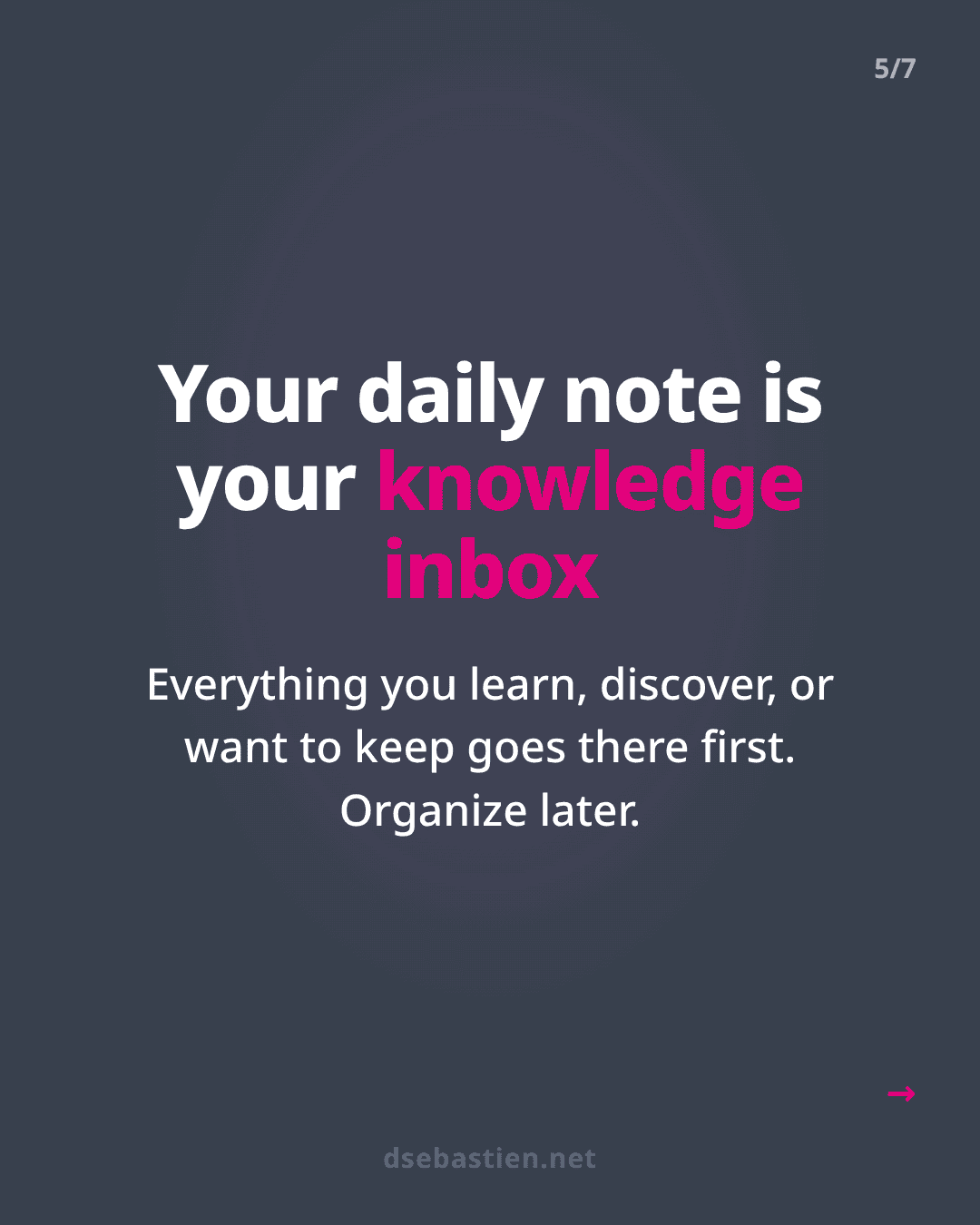
The benefit is simple: you stay focused on what you're doing. You don't waste time creating new notes, adding metadata, and linking things right away. You jot your ideas down, knowing they're now part of your trusted system. You can process them later, during your Periodic reviews.
If you've ever lost a great idea because creating "the right note" felt like too much friction in the moment, this is for you.
Journaling links your knowledge with time
There's another benefit I find underrated: capturing knowledge in your daily notes links it with time.
When you look back at your notes from last week, last month, or last year, you know exactly when you discovered an idea, or when a new iteration of an existing idea made it into your knowledge base. "Oh, this is when I discovered this." "This is when I worked on that."
Your notes become a timeline of your thinking. I find that really valuable.
Keep your journal in your Tool for Thought
It goes without saying, but your journal should live in your Tools for Thought (TfTs), right next to every other note in your knowledge base. Not in a separate app.
That's what turns a diary into the entry point of your knowledge system. The links, the searches, the reviews: everything works across your journal and your notes.
Conclusion
Journaling is not only a personal development practice. A daily note gives you one place to plan your day, track your life, think in writing, and capture everything you learn. It keeps you focused, it feeds your knowledge base, and it records when your ideas were born.
If you want to build a solid knowledge management practice, I urge you to seriously consider journaling.
And if you want to go deeper, the full Knowledge Management for Beginners course walks you through the whole system, from capture habits to atomic notes to AI: https://knowledge-management-for-beginners.com

That's it for today! ✨
About Sébastien
Ready to get to the next level?
Found this valuable? Share it with someone who needs it.