
Tools
Give your AI superpowers with the Obsidian vault I run my whole business from
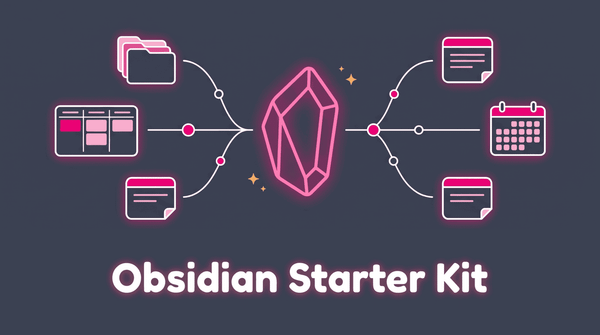
Obsidian Starter Kit v5: the AI-ready vault I run my whole business from. Your AI knows your context, does the work, and it's ready on day one.
Tools
Obsidian Starter Kit v5: the AI-ready vault I run my whole business from. Your AI knows your context, does the work, and it's ready on day one.
RLCD is how TypeSafe AI says it trains Jev. The name stands for Reinforcement Learning for Calibrated Decisions, and the pitch fits in one line from their docs: RLCD "trains TypeSafe to return decisions and calibrated probabilities instead of generated text."
I just released a new plugin: Agentic Resource Discovery Server plugin for Obsidian. It turns your vault into a local registry for your AI skills and agents. Your AI assistant searches that registry when it needs something, and fetches only that.
A decision model (DM) is an AI model whose output is a decision, not text. You give it an input and a bounded set of possible answers, and it gives you back numbers: which option, how likely yes is, what score. It's the category Jev belongs to, and I think it deserves its own name next to Large Lang
A System One model is TypeSafe AI's name for a general-purpose decision model). It takes context and a set of typed questions and returns probabilities: which option, yes or no, what score. It doesn't generate text. The name comes from Daniel Kahneman's two systems in Thinking, Fast and Slow): Syste
fast-jev-compaction is an MIT-licensed plugin for Claude Code by Tamara Tran that replaces summary-based compaction with Jev decisions. The question behind it is a good one: why is compaction still a summarization prompt in 2026?
Projects is a Claude Code feature launched in beta on 2026-09-17, on desktop and web (cloud sessions), for select Pro and Max users. Anthropic says it's coming to all Claude users soon. By early October 2026 the docs describe it as a public beta on Pro and Max.
Less than two months after Claude Opus 5, Anthropic just released Claude Opus 5.5. It's the first model of the new Claude 5.5 family, and Sonnet 5.5 and Haiku 5.5 are coming "in the coming weeks".
When you run several Claude Code sessions in parallel, YOU are the orchestrator: you open five sessions, try to remember which one does what, and copy context from one to the other by hand.
Some of the LLM calls in an AI agent or automation are really decisions: Is this email urgent? Which tool should I call? Is this paragraph off-topic? Is the agent stuck?
I'm using Git worktrees more and more, mostly because every parallel coding agent needs its own working directory. And sooner or later, you hit the question from this Stack Overflow thread: I changed something in worktree A, how do I get it into worktree B? Is there a `git worktree pull`?
Here's a little-known tip for Obsidian. Images can be placed side by side in obsidian, if they are on the same line and their size allows them to. If you have a first image with a width of 200px and a second one a width of 300px, you can use `` to display those side by side, if your note has at leas
A clear roadmap to building your own knowledge system. Subscribe and get it straight to your inbox.
6,000+ readers. No spam. Unsubscribe anytime.