
Sort your work by what it is and your lists will stop lying


The usual fix for a messy workload is a single list. It holds up until that list contains the book you want to write, the report you send every Friday, a dentist appointment and a side business you dream about building. Everything on it looks the same, so the list can't tell you what matters, what is late, or what you should drop.
In this article, I want to share the mental model I use to fix that. It boils down to one idea: sort your work by what it is.
Busy all week, with little to show for it
Let's suppose you know your values, your goals and your priorities. Now what?
Many people are stuck there. They have goals but no plan. Plans but no projects. Projects but no concrete tasks. And so they drift: busy all week, with little to show for it.
The way out is to stop treating all your work as one kind of thing. Options aren't commitments. Ongoing work isn't finite work. Mix them up and you're lying to yourself, doing yourself a disservice. Every undecided or unfinished item is an open loop. Open loops are exhausting: the fewer you have, the better and more focused you'll feel.
The ladder, from strategic to tactical
What you need is an action system. Think of it as a ladder with six kinds of action on it:
| Level | The question it answers | Time horizon | How it ends |
|---|---|---|---|
| Idea | Should I do this at all? | None yet | You promote it or drop it |
| Goal | What do I want to be true? | Months to years | You achieve it or abandon it |
| Plan | How will I get there? | Months to quarters | You apply it, revise it or reject it |
| Project | What do I deliver next? | Weeks to months | You complete it or abandon it |
| Activity | What do I keep doing? | Ongoing | Only when you decide to retire it |
| Task | What do I do today? | Today or this week | It's done |
Ideas feed in from the side, and each one can become any of the others.
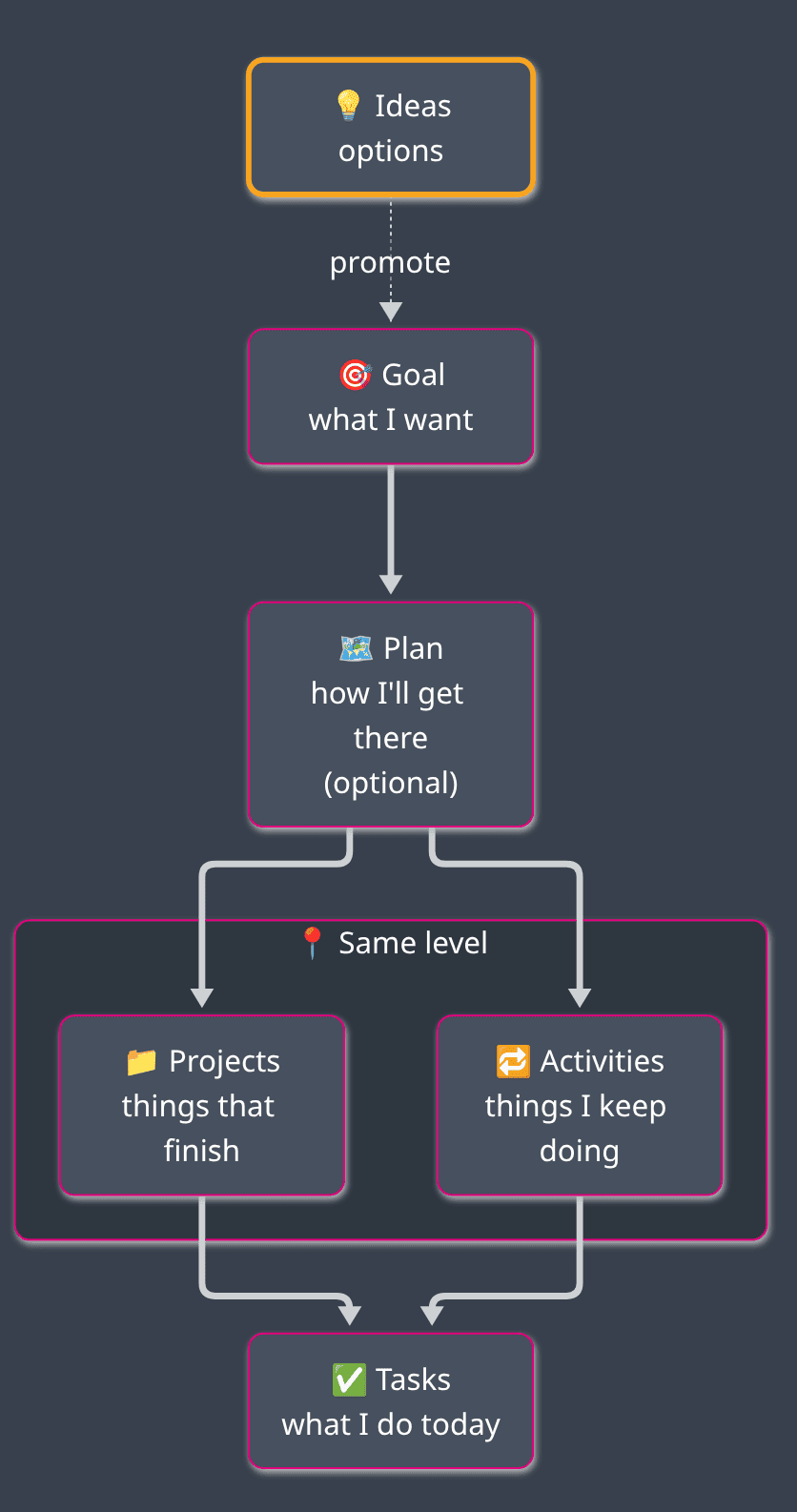
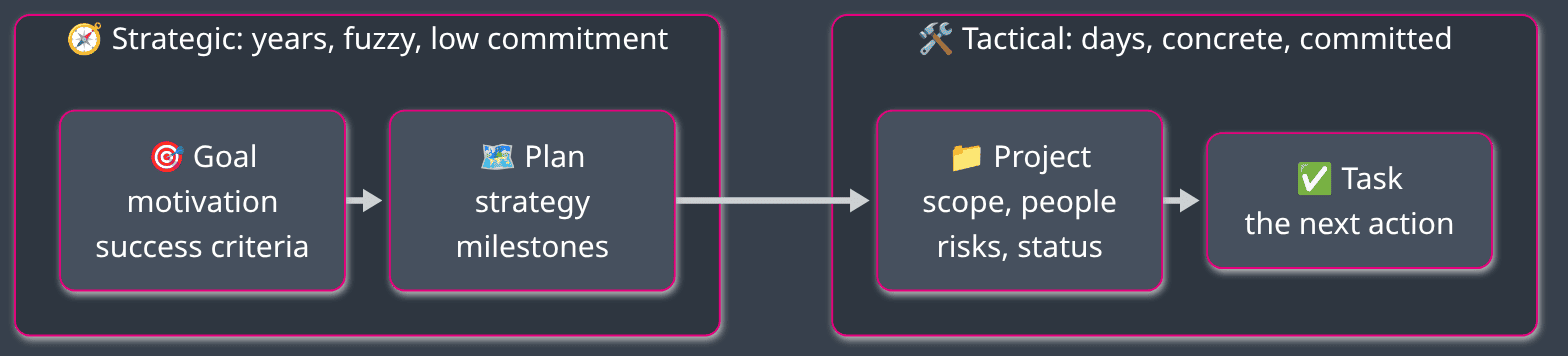
As you go down the ladder, four things change at once:
- The time horizon shrinks. Years at the top, hours at the bottom.
- Concreteness grows. "Lead a team" is fuzzy; "book the training" is something you can finish before lunch.
- Commitment grows. An idea costs you nothing. A task on today's list is a promise you'll keep or break by tonight.
- The information gets more operational. A goal carries your motivation and what success looks like. A plan carries the strategy and its milestones. A project carries the scope, the people involved, the risks and where it stands. A task carries one thing: the next action.
Let's follow one example all the way down. You're a senior analyst, and one day it hits you: "I could become a team lead." That's an idea.
Ideas: committing is expensive
A goal or a project is a promise to yourself. Every promise you don't keep makes your lists noisier and your reviews heavier. Yet ideas arrive all the time, and losing them would be a waste.
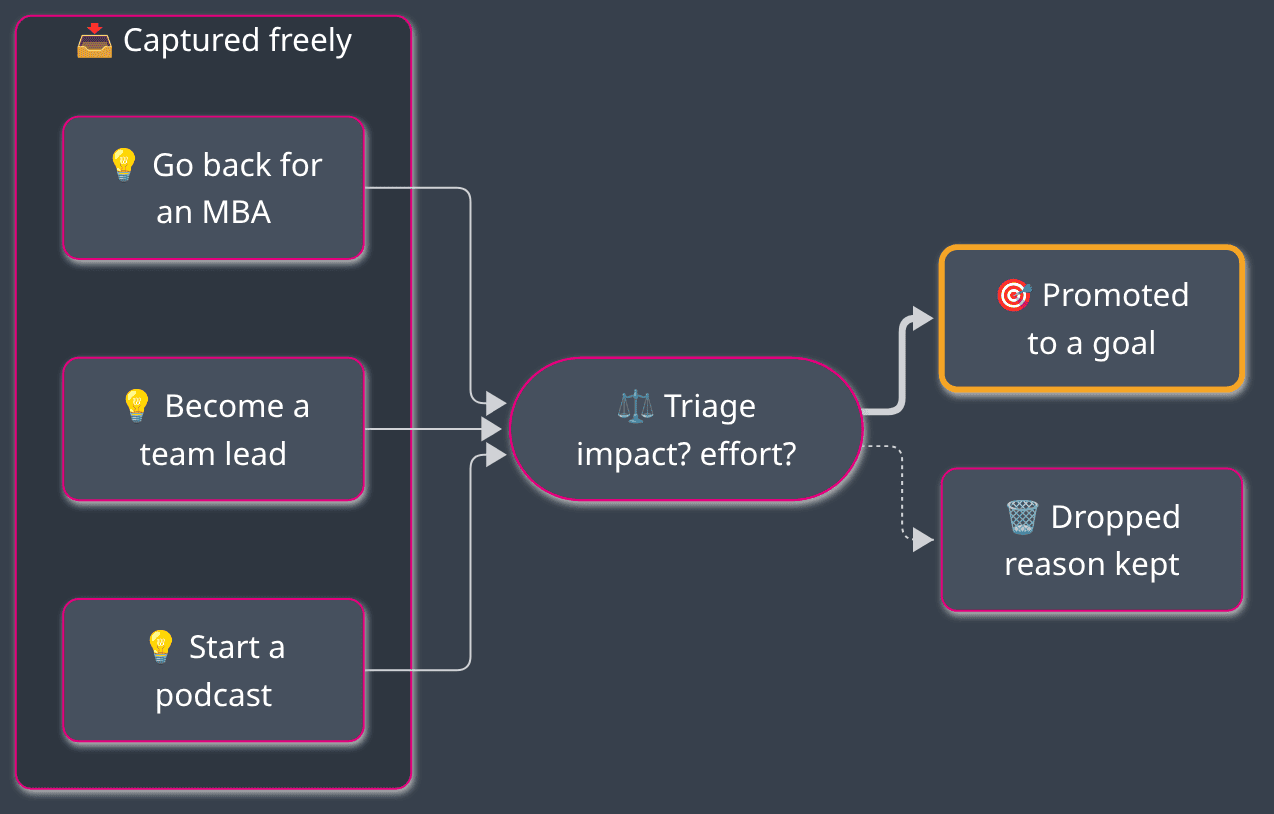
The answer is a funnel. Capture ideas freely, without committing to any of them. Then triage them regularly with two questions: what's the impact if I do this, and what's the effort? Each idea then ends in one of two ways. Either it gets promoted to a goal, a plan, a project, an activity or a task. Or it gets dropped, and you write down why.
Over a few weeks, three ideas land in our analyst's funnel: become a team lead, start a podcast about data analysis, and go back to school for an MBA. The podcast is high effort with no clear payoff for their career right now: dropped. The MBA would take two years of evenings and cost a fortune, while the company promotes on track record anyway: dropped, with that exact sentence written next to it. "Become a team lead" survives and gets promoted to a goal.
I used to model my own product ideas as projects or goals, parked at an "Idea" status. Dozens of them. Every time I opened my goals view, half of it was wishes, and my actual goals were buried under things I had never committed to.
Goals and plans: the strategic layer
A goal describes what you want to be true, and why. It connects to your values, your purpose and your priorities.
Our analyst's goal: lead a team within two years. The motivation is written down (more influence over how the work gets done, a step toward the career they want), and so is the success criterion: holding the title, with people reporting to them.
A plan describes how you'll get there: the strategy, the phases, the milestones. Plans are optional, and I strongly believe most goals don't need one. Write a plan when the goal is ambitious or complex: the path isn't obvious, it will take several projects, or you're choosing between competing approaches. The plan is where you write down why you picked approach A over approach B, which pays off the day you start doubting it.
Our analyst's goal qualifies. There are several ways to get a lead role (internal promotion, switching companies, taking over a team after a reorg), so they write a plan: build leadership skills and visibility inside the company. Switching companies goes into the plan as the rejected alternative, with the reason.
 Richard Elliott
Projects end, activities don't
A project is a time-bound effort with a deliverable. It starts, it ends, and you can tell whether it succeeded. Our analyst's plan spawns two:
- Leadership training: pick a course, take it, finish it this quarter.
- Lead a cross-team initiative: volunteer to run the next data migration involving two other teams.
But a lot of what you do never ends. Your weekly reporting. Maintaining a tool your team relies on. Your day job itself. And it goes well beyond work: driving the kids to school, playing tennis, watching movies, maintaining products, handling customer support... The PARA method calls these areas of responsibility. I call them activities.
Instead of a deadline and a deliverable, an activity has a cadence (how often you do it) and a standard (what "good enough" looks like). You measure it by the cadence you keep, never by a percentage. It never completes; you retire it, deliberately, the day you stop doing it.
Our analyst adds one: weekly mentoring of a junior colleague. One hour every week, with the standard that the junior leaves each session with one concrete thing to try.
Not sure which one you're looking at? Ask what "finishing" would even mean. If it ships, it's a project. If you'd just stop doing it at some point, it's an activity. A project that has been active for over a year with no plausible end date is an activity in disguise.
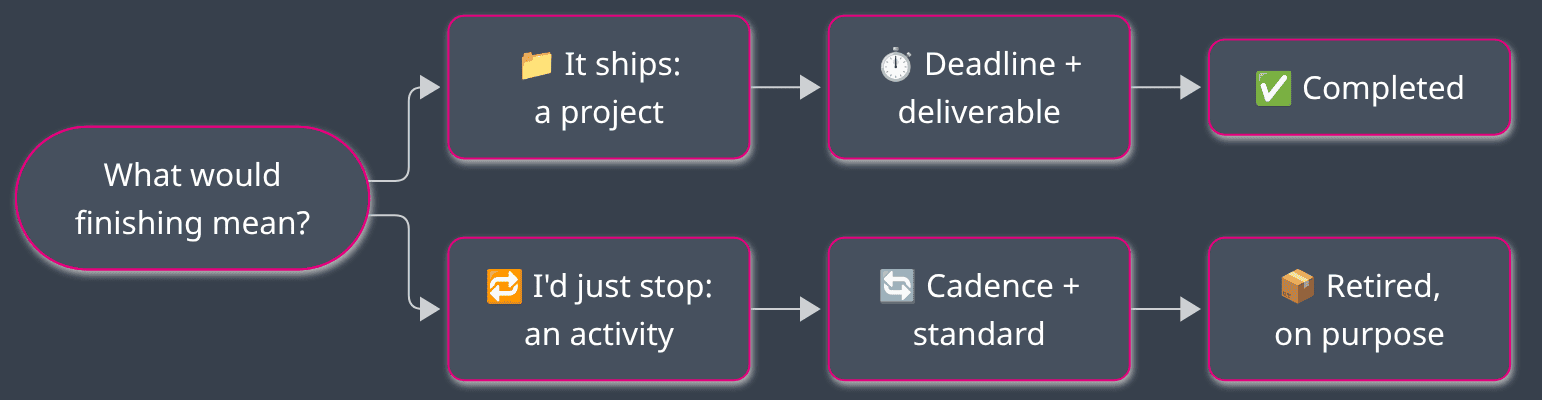
My newsletter lived in my projects for a long time, and it never reached 100% (obviously). Filed as an activity, it gets measured by the cadence I keep, and my project list only holds things that can actually finish.
Tasks: where the work happens
A task is a single piece of work you can finish in a day or, ideally, less. If it takes longer, it's a project in disguise. Our analyst's first task: book the leadership training this week. It fits in ten minutes and gets done by Friday.
That's the whole ladder for one goal:
- Idea: become a team lead (the podcast and the MBA were dropped)
- Goal: lead a team within two years
- Plan: build leadership skills and visibility
- Projects: leadership training; lead a cross-team initiative
- Activity: weekly mentoring of a junior colleague
- Task: book the training this week
Four traps the ladder helps you avoid
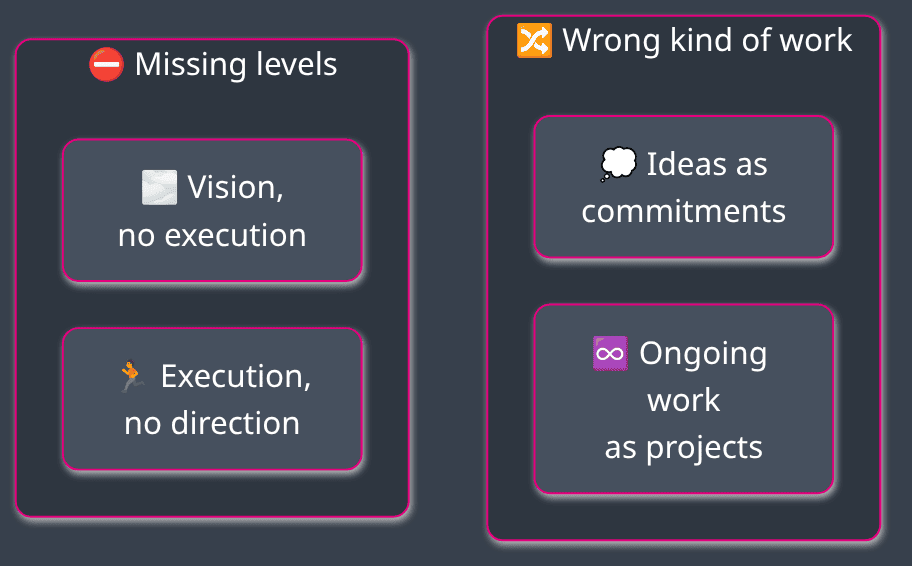
All vision, no execution. You have inspiring goals, but you never break them down into concrete work. You feel motivated, yet you make no real progress.
All execution, no direction. You complete tasks, answer emails, tick boxes. But at the end of the week, you can't point to progress on anything that matters to you.
Ideas posing as commitments. Every "maybe someday" sits in your goals or projects list. Your lists look ambitious and feel crushing, and since you can't tell what you've committed to, you can't tell what's late.
Ongoing work posing as projects. Your recurring work sits in your project list, stuck at 60% forever. Deadlines get pushed every month, the real projects drown among them, and after a few months you stop opening the list at all.
Links, not a tree
It's tempting to picture all of this as a neat tree, where every task has exactly one parent. Real work doesn't look like that.
The cross-team initiative moves our analyst toward the team lead goal, and it also serves a second one: becoming the go-to person for data quality. Preparing a mentoring session about how to run a kickoff meeting feeds the weekly mentoring AND the cross-team initiative. So connect your actions with links, and let each piece of work point to everything it serves.
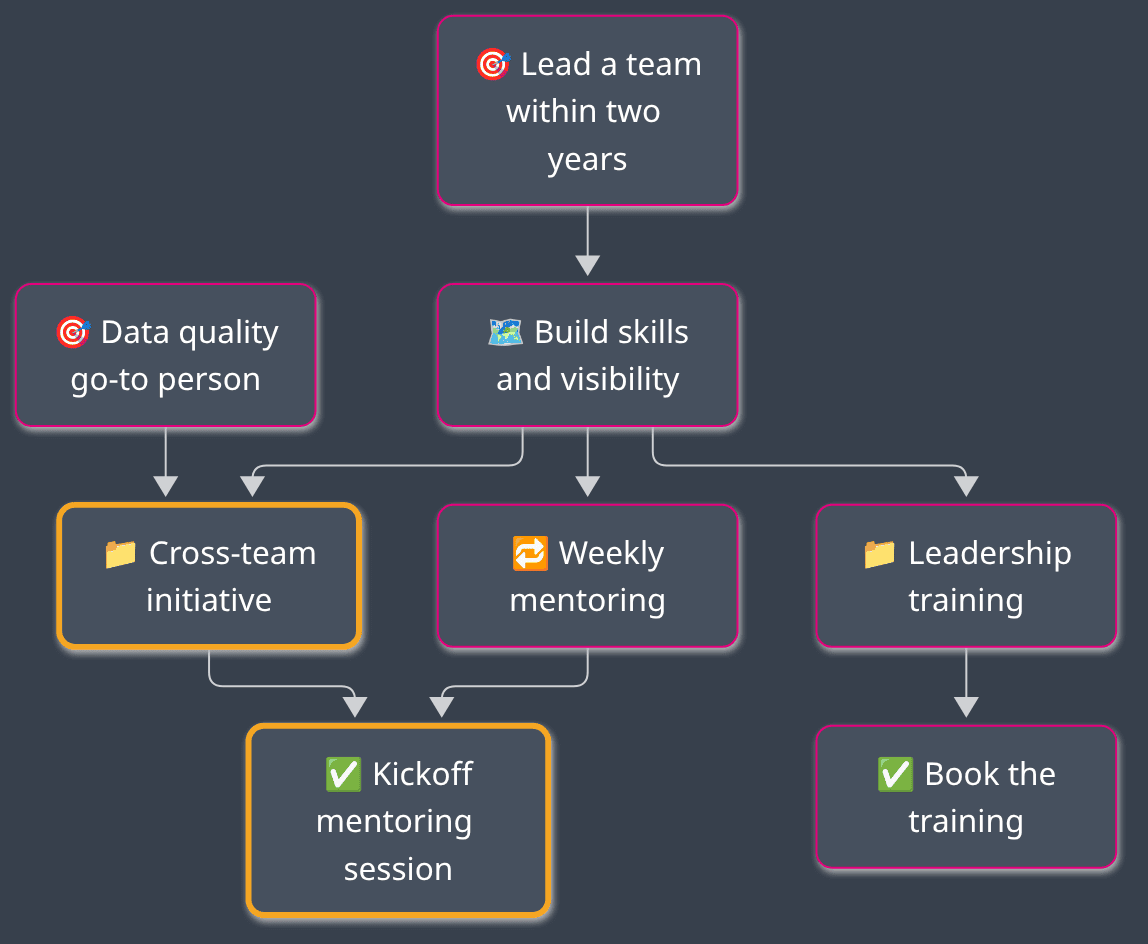
You also don't need every level every time. A small goal can go straight to tasks. An activity can hold tasks directly, without a project wrapper. A self-contained project doesn't need a goal above it. Create the levels that carry useful information and skip the rest. Start simple. Avoid complexity like the plague. You can always break things down and add levels later.
Start at the top
Most people build their action system from the bottom up: a task list they try to get through each day. That's backwards. Start from your values, goals and priorities, and work your way down:
- Empty your head into the idea funnel. Everything you might do goes there first, not into your goals.
- Pick a handful of active goals. Don't try to do everything at once. Pace yourself.
- Write plans only where the path isn't obvious.
- Separate projects from activities. Things that finish go one way, things you keep doing go the other.
- Pull tasks from projects and activities. Only what you can do this week.
Then check the ladder from the bottom up. Pick any task and trace it upward. If you can't say what it serves, either a link is missing, or the task doesn't deserve your time.
Your task list for the week should feel approachable, not overwhelming. And for each task on it, you should know exactly which goal it serves.
Keep the system alive
An action system rots if you don't look at it. Each level needs its own rhythm:
- Ideas: at least once a quarter, so the funnel doesn't turn into a graveyard.
- Goals and plans: monthly, quarterly and yearly. Are you still heading in the right direction? Are your goals still aligned with who you want to become and the life you want to live?
- Projects and activities: weekly and monthly. Are the projects moving? Did you keep each activity's cadence?
- Tasks: daily and weekly. What's the most important thing to do today, and this week?
That's what periodic reviews are for. Without them, tasks pile up, projects stall, ideas sneak into your goals, and goals drift away from your values.
Everything is connected
Last but not least: your systems are interconnected. Clarity feeds your action system, which feeds your periodic reviews. The reviews feed your knowledge management, and what you learn there sharpens your clarity in turn. And your productivity, health and time management systems influence everything else.
Systems are interconnected
Conclusion
Going from clarity to action takes a system; motivation alone won't carry you there. Sort your work by what it is, keep options in the funnel until you commit, and give ongoing work a cadence instead of a deadline. The goal isn't to be busy. It's to make progress on what matters most.
This article covers the model. The Knowledge Worker Kit goes much deeper, from getting clear on your values, goals and priorities to running periodic reviews, managing your tasks and actually getting them done:
 Richard Elliott
And if you use Obsidian, the Obsidian Starter Kit implements this model out of the box. It's still up to you to use it well, though 😉
 Dwayne Appleby

That's it for today! ✨
Go Further
 Sébastien Dubois
 Sébastien Dubois
 Sébastien Dubois

About Sébastien
Ready to get to the next level?
Found this valuable? Share it with someone who needs it.